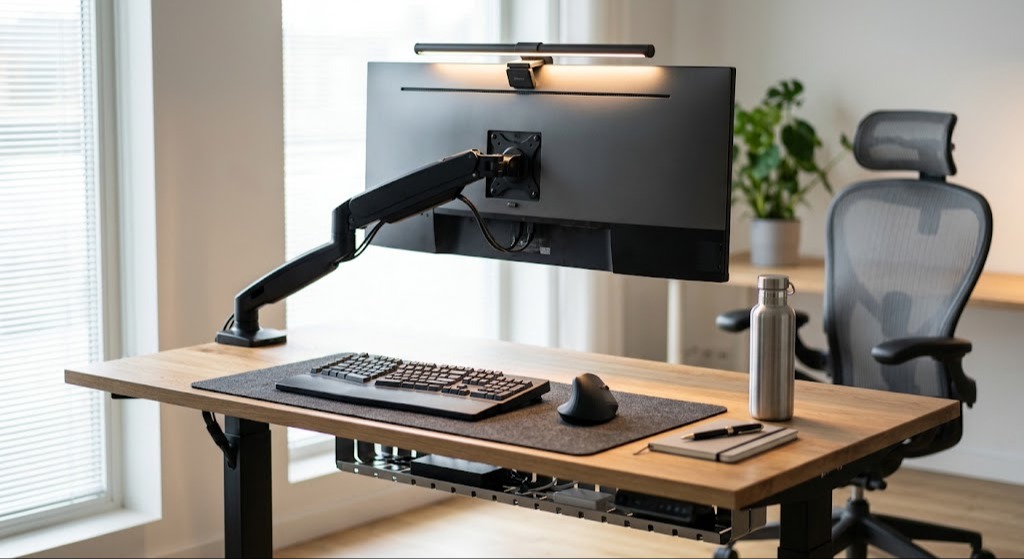

Useful desk accessories are ergonomic, spatial, and electrical tools engineered to optimize a physical workstation for physiological comfort, cognitive focus, and operational efficiency. By anchoring displays at biomechanical eye level, organizing desktop zones within direct reach envelopes, and consolidating high-wattage power, these accessories eliminate physical strain and visual distraction.
+-------------------------------------------------------------------------------+
|                            KEY FACTS: AT A GLANCE                             |
+-------------------------------------------------------------------------------+
| • Primary Reach Envelope: High-frequency tools belong within a 14-to-16-inch  |
|   radius from the torso to prevent repetitive strain and trapezius fatigue.   |
|                                                                               |
| • Display Alignment: Gas-spring monitor arms position screens so the top line |
|   of text sits at or slightly below eye level, keeping vertical gaze within   |
|   15 to 20 degrees.                                                           |
|                                                                               |
| • Asymmetric Lighting: Monitor light bars deliver 300 to 500 lux of surface   |
|   illumination without casting specular reflections on displays.              |
|                                                                               |
| • GaN Power Delivery: Gallium Nitride charging hubs cut desktop power footprint|
|   by 40 to 60 percent while supplying 65W to 140W+ USB-C Power Delivery.      |
|                                                                               |
| • Desk Protection: Desk mats measuring 3mm to 5mm thick dampen keyboard sound |
|   resonances between 500Hz and 1000Hz while standardizing mouse tracking.     |
+-------------------------------------------------------------------------------+
How Should You Structure Your Desk Zones for Maximum Efficiency?
Desk organization follows the neutral reach envelope principle of industrial ergonomics: layout is dictated by frequency of physical interaction, not aesthetic balance. Placing high-frequency accessories outside their natural zone creates cumulative trapezius fatigue, wrist flexion, and spinal rotation.
+-------------------------------------------------------------------------------+
|                        DESK ERGONOMIC REACH ZONES                             |
+-------------------------------------------------------------------------------+
|                                                                               |
|       [ZONE 3: OUTER DISPLAY & ANCHOR ZONE] (> 24 in / 60 cm)                 |
|       - Articulating Monitor Arms                                             |
|       - High-Output Monitor Light Bars                                        |
|       - Multi-Device GaN Charging Stations                                    |
|                                                                               |
|       [ZONE 2: SECONDARY REACH ZONE] (14 to 24 in / 35 to 60 cm)              |
|       - Vertical Laptop Clamshell Docks                                       |
|       - Modular Magnetic Storage & Reference Trays                            |
|       - Desktop Audio Dials / Macro Pads                                      |
|                                                                               |
|       [ZONE 1: NEUTRAL REACH ENVELOPE] (< 14 to 16 in / < 35 to 40 cm)        |
|       - Primary Mechanical Keyboard & Split Ergo Boards                       |
|       - High-Precision Ergonomic Mouse / Trackball                            |
|       - 3mm to 5mm Wool Felt or Textured Desk Mat                             |
|                                       \                                       |
|                                     [USER]                                    |
+-------------------------------------------------------------------------------+
Zone 1: The Neutral Reach Envelope (< 14 to 16 inches)
The primary zone is bounded by the sweep of your forearms while your upper arms remain resting at your sides and your elbows sit at roughly 90-degree angles. This surface houses only continuous-touch tools: your primary split or compact keyboard, ergonomic vertical mouse or trackball, and a protective desk mat. Restricting this zone to direct-input peripherals eliminates ulnar deviation and forearm pronation.
Zone 2: The Secondary Reach Zone (14 to 24 inches)
The secondary zone is reached by extending your arm from the elbow without bending at the waist or rotating your torso. Place daily utility items here: vertical laptop docks, modular stationery trays, active drinkware, and hardware volume controllers or macro pads. You should be able to access these accessories with a single elbow extension.
Zone 3: The Outer Perimeter (> 24 inches)
The tertiary zone extends beyond comfortable physical reach and holds passive structural hardware. Articulated monitor desk mounts, monitor task light bars, desktop charging hubs, and under-desk cable management trays belong here. Items in this zone supply environmental support—power, illumination, and screen suspension—without cluttering physical input space.
Ergonomic Baseline: Display and Laptop Elevation
Lifting displays off the desk surface is the single highest-yield modification you can make to a workspace. It simultaneously resolves visual ergonomics and reclaims usable surface area.
                    MONITOR POSITIONING & SIGHT LINES

        Horizontal Eye Level -----------------------------+
                                 \ -15° to -20°           | Top 1/3 of Screen
                                  \ Gaze Angle            v
                                   \             +-----------------+
                                    \            | [Monitor Screen]|
                                     v           |                 |
                               +---------------+ |                 |
                               |     User      | +-----------------+
                               |   (Upright)   |          |
                               +---------------+     [Monitor Arm]
                                      |                   |
               Desk Surface =======================================
1. Monitor Arms: Mechanical Coil vs. Gas-Spring Articulation
A monitor arm secures to the back or edge of your desk via a C-clamp or grommet mount. Suspending the screen clears the bulky, dead footprint of factory stands, giving you back 1.5 to 2.5 square feet of usable desktop.
- Gas-Spring Arms: Gas-spring arms use a cylinder of pressurized nitrogen gas to counterbalance the monitor’s weight. They allow smooth, single-handed repositioning across three dimensions, making them ideal if you regularly switch between sitting and standing heights. Keep in mind that gas seals gradually lose pressure over 5 to 7 years, requiring periodic tension tuning.
- Mechanical Coil-Spring Arms: Mechanical spring arms use tempered steel coils under physical tension. While they require slightly firmer effort to adjust than gas struts, coil springs do not leak, typically outlasting gas equivalents by a decade or more. They are especially reliable for static setups holding heavy ultrawide displays (34 to 49 inches) weighing between 20 and 40 pounds.
When choosing an arm, verify that its VESA plate matches your display (typically 75×75mm or 100×100mm) and confirm that its weight bracket aligns with your display without its factory base.
2. Laptop Elevation: Active Risers vs. Vertical Clamshell Docks
Placing a laptop flat on a desk forces your cervical spine into downward flexion, increasing effective head weight on your neck from an upright 10–12 pounds to as much as 45–60 pounds at a 45-degree tilt.
+-------------------------------------------------------------------------------+
|                       LAPTOP ELEVATION COMPARISON                             |
+-------------------------------------------------------------------------------+
| Feature              | Active Ergonomic Riser    | Vertical Clamshell Dock    |
+----------------------+---------------------------+----------------------------+
| Primary Objective    | Dual-screen workflow      | Minimalist desktop footprint|
| Screen Functionality | Active secondary screen   | Fully disabled/closed      |
| Heat Dissipation     | Moderate (chassis lifted) | High (vertical convection) |
| Usable Desk Reclaimed| 0.5 to 0.8 sq ft          | 1.0 to 1.4 sq ft           |
| Required Peripherals | External mouse & keyboard | External monitor, mouse, kb|
+----------------------+---------------------------+----------------------------+
Elevating a laptop on an open riser lets you align its panel next to a primary monitor, but the screens must share a consistent visual height. Place the top third of both displays level with your horizontal line of sight to avoid fatiguing neck pivots.
If you use external monitors exclusively, a vertical gravity dock stores your closed laptop upright. This orientation reduces its desktop footprint by roughly 85% while exposing the bottom chassis vents to open air, improving passive cooling and preventing thermal throttling.
Desktop Surfaces and Physical Organization
Desk mats and organizational trays establish tactile control, balance desk acoustics, and prevent clutter from migrating across your workspace.
             ACOUSTIC & SURFACE DAMPENING OF A DESK MAT

       Keyboard Keystroke Impulse
                  |
                  v
      +-----------------------+
      |  Mechanical Keyboard  |
      +-----------------------+
                  |  Resonance Vibrations (500Hz - 1000Hz)
                  v
    =============================  <-- [Desk Mat: 3mm to 5mm Felt/Leather]
    -----------------------------  <-- Absorbent Core Layer
    =============================  <-- Desk Surface (Solid Wood / MDF)
                  |
                  v  (Attenuated Mechanical Echo)
1. Desk Mats: Friction Coefficients and Acoustic Dampening
A desk mat functions as an acoustic barrier, an optical mouse tracking surface, and a visual boundary for your primary work area.
- Merino Wool Felt (3mm to 5mm): High-density natural felt absorbs high-frequency keyboard clatter, especially hollow resonance between 500 Hz and 1000 Hz. Wool fibers offer low initial static friction, allowing easy wrist movements during typing. However, felt provides higher dynamic friction than synthetic weaves, which can slow down rapid gaming mouse inputs. It also requires dedicated spot-cleaning if exposed to liquids.
- Top-Grain and Vegetable-Tanned Leather: Leather creates a firm, durable writing surface with moderate mouse resistance. Natural leather resists minor spills and develops an aesthetic patina over years of use, but it requires periodic conditioning to prevent drying and edge curling in low-humidity environments.
- Textured PU / Synthetic Polyurethane: A cost-effective, completely waterproof alternative. It cleans easily with a damp microfiber cloth, but synthetic mats lack the acoustic dampening of thick wool and can feel clammy against bare arms during extended work sessions in warm rooms.
2. Horizontal Decluttering: The “Visual Horizon” Principle
Clutter directly degrades cognitive focus: visible, disorganized items constantly compete for neural processing resources in your visual cortex. Modular storage trays counteract this when used with a visual horizon rule: no storage tray or organizer should rise above the lower bezel of your primary monitor.
Keep pens, sticky notes, storage drives, and flash cards inside low-profile, modular magnetic trays that dock together cleanly. Grouping small tools into a single, low-profile footprint prevents items from scattering across your desk.
Power Distribution and Cable Management
Modern workstations run on multiple high-wattage power lines, display feeds, and peripheral connections. Leaving these cables unmanaged introduces electromagnetic interference, creates physical snag points, and adds visual chaos to your setup.
                   OPTIMAL DESK WIRING TOPOLOGY

       [ Wall Outlet / Surge Protector ]
                      |
                      v (Single Heavy-Duty AC Trunk Line)
     +---------------------------------------------------+
     |        Under-Desk Wire Basket / Raceway           |
     |  +---------------------------------------------+  |
     |  | Multi-Outlet Surge Strip + AC Power Bricks  |  |
     |  +---------------------------------------------+  |
     +---------------------------------------------------+
           |                     |                 |
     (Short DC Run)        (Short DC Run)    (Single USB-C PD)
           |                     |                 |
           v                     v                 v
     [Monitor 1]           [Monitor 2]       [GaN Desktop Block]
                                                   |
                                            +------+------+
                                            |             |
                                            v             v
                                        [Laptop]      [Phone/Acc]
1. Under-Desk Cable Trays: Open Wire Baskets vs. Enclosed Raceways
Eliminating cord clutter requires dropping all power distribution bricks and slack lines into an under-desk wire raceway secured to the underside of the desktop.
- Open Steel Wire Baskets: Open wire grids allow continuous air circulation around bulky AC-to-DC transformer bricks, which can reach operating temperatures between 105°F and 140°F (40°C to 60°C). They make it easy to drop in and reroute cables without disassembling the entire tray, making them the most versatile choice for changing hardware configurations.
- Enclosed J-Channels and Privacy Skirts: Extruded plastic J-channels create a sleek, clean profile that conceals cables entirely from view. However, they quickly run out of room when housing high-wattage power supplies, and sliding thick braided cords through narrow channel gaps can be frustrating. Use enclosed channels for lightweight data runs and reserve open baskets for heavy power hardware.
Run a single, heavy-duty surge-protected trunk line from the wall outlet to the under-desk tray. From there, route clean, direct lines up to your monitors and desktop peripherals using hook-and-loop straps rather than plastic zip ties, which can crimp internal shielding and damage data cables over time.
2. Desktop Power: Gallium Nitride (GaN III / GaN IV) Charging Hubs
Replacing multiple proprietary charging bricks with a single multi-port Gallium Nitride (GaN) charger frees up significant physical space while cutting down on thermal waste. GaN semiconductors transfer power across smaller components with higher electrical efficiency than traditional silicon chips, running cooler under load and taking up roughly half the space.
+-------------------------------------------------------------------------------+
|                         USB-C PD 3.1 POWER ALLOCATION                         |
+-------------------------------------------------------------------------------+
| Device Class           | Required Continuous Wattage | Recommended Port Spec  |
+----------------------+-----------------------------+--------------------------+
| Workstation Laptop   | 96W to 140W                 | USB-C PD 3.1 (EPR 28V/5A)|
| Ultrabook / MacBook  | 60W to 70W                  | USB-C PD 3.0 (20V/3.25A) |
| Tablet / iPad Pro    | 30W to 45W                  | USB-C PPS / PD           |
| Flagship Smartphone  | 20W to 30W                  | USB-C PD Fast Charge     |
| Peripherals / Mice   | 5W (low draw)               | USB-A / USB-C Standard   |
+----------------------+-----------------------------+--------------------------+
When selecting a multi-port GaN charging hub, look for dynamic power allocation. A quality 140W GaN desktop block will automatically adjust its output: it can deliver a full 100W down a primary line to charge a laptop under heavy processing loads, while routing the remaining 40W across secondary ports to power a tablet and smartphone without dropping the main connection.
Task Lighting: Monitor Light Bars vs. Traditional Lamps
Traditional swing-arm task lamps illuminate desks from the side, which often creates harsh, uneven shadows and reflects glaring light spots across computer screens. Monitor light bars solve this by mounting directly above the workspace.
             ASYMMETRIC OPTICAL PATH: ZERO SCREEN GLARE

                [Monitor Light Bar]
                     |      \
      Display Panel  |       \
            |        |        \  Asymmetric Beam Angle
            |        |         \ (Directed downward & forward)
            v        |          \
        +-------+    v           \
        |       |  [Cutoff Plane] v
        |Screen |   |
        |       |   |             +-------------------------+
        +-------+   v             | Targeted Desk Workspace |
          Desk Surface ========>  +-------------------------+
                                  (300 to 500 Lux Uniform)
1. Asymmetric Optical Design and Glare Prevention
A well-designed monitor light bar uses an asymmetric optical lens that shapes light into a forward-angled beam. This design creates a sharp optical cutoff plane: light sweeps downward across the desktop surface directly in front of the display without washing out the screen panel itself.
This directional path eliminates the veiling reflections and specular glare that cause pupillary fatigue during long work sessions. By mounting to the top of your monitor with a balanced counterweight, the light bar also illuminates your primary typing and reading area without consuming any desktop surface space.
2. Photometric Targets: Lux and Color Rendering (CRI)
- Target Desk Illuminance: Keep task illuminance across your primary work surface between 300 and 500 lux, matching the guidelines of the Illuminating Engineering Society (IES). This range balances the ambient light of your room with the luminance of your monitor, helping to prevent eye strain.
- Color Rendering Index (CRI): Choose fixtures with a CRI rating of $Ra \ge 95$. High CRI LEDs produce a continuous light spectrum that shows colors accurately on physical media, preventing the dull, washed-out tones common under cheap office lighting.
- Correlated Color Temperature (CCT): Use lights with adjustable color temperature to support your natural circadian rhythms: set the bar to a crisp 4000K to 5000K during peak morning work to support daytime focus, and dial it down to a warm 2700K to 3000K in the evening to reduce blue-light exposure before bed.
Core Desk Accessories: Feature and Metric Comparison
This matrix breaks down key functional performance metrics, useful lifespans, and physical engineering trade-offs across essential desk accessories.
| Accessory Type | Core Function | Critical Metric / Engineering Spec | Typical Lifespan | Primary Benefit | Notable Trade-off / Limitation |
| Gas-Spring Monitor Arm | Screen suspension & articulation | 10 to 32 lbs capacity; VESA 75/100 compatible | 5 to 8 Years | Fluid single-handed multi-axis display positioning | Internal nitrogen gas cylinder gradually loses pressure over time |
| Mechanical Monitor Arm | Static heavy-load suspension | 20 to 45+ lbs capacity; tempered coil springs | 15+ Years | Long-term mechanical stability for heavy ultrawides | Requires firmer manual effort to adjust positioning |
| Wool Felt Desk Mat | Acoustic damping & surface boundary | 3mm to 5mm thickness; high-density wool | 2 to 4 Years | Absorbs keyboard resonance between 500Hz and 1000Hz | Demands prompt spot-cleaning; introduces higher dynamic friction |
| Leather Desk Mat | Smooth writing surface & durability | 2mm to 3mm thickness; top-grain leather | 7 to 10+ Years | Durable, easy-to-clean surface that develops an attractive patina | Can dry out or curl at edges in sustained low-humidity rooms |
| Monitor Light Bar | Glare-free task illumination | $\ge 95\text{ CRI}$; 300 to 500 lux; asymmetric beam | 6 to 10 Years | Illuminates desk surface with zero monitor screen glare | Mounts awkwardly to curved monitors or panels with thick rear bezels |
| GaN Charging Station | High-wattage power consolidation | 100W to 140W+; USB-C PD 3.1 EPR support | 4 to 6 Years | Powers laptop, phone, and tablet through a single small footprint | High continuous power draw causes charger housing to run warm |
| Under-Desk Cable Tray | Wire containment & power storage | Welded carbon steel wire grid; 4 to 6 in depth | 20+ Years | Prevents cable snags and dissipates heat from AC power supplies | Requires drilling mounting screws directly into the underside of the desk |
| Vertical Laptop Dock | Clamshell laptop storage | Solid aluminum unibody; silicone-lined channels | 15+ Years | Frees up roughly 85% of closed laptop’s desk footprint | Prevents using the laptop’s built-in keyboard, trackpad, and screen |
Diagnostic Troubleshooting: Solving Common Workspace Setup Failures
     +-------------------------------------------------------------------------------+
     |                     DIAGNOSTIC WORKSPACE TROUBLESHOOTING                      |
     +-------------------------------------------------------------------------------+
| Symptom                 | Root Mechanical/Electrical Cause| Immediate Corrective Action |
+-------------------------+---------------------------------+-----------------------------+
| Monitor Arm Drifts Down | Gas spring counter-tension set  | Turn arm joint hex screw    |
|                         | lower than weight of screen     | toward (+) until display sits|
|                         |                                 | stable at any height.       |
+-------------------------+---------------------------------+-----------------------------+
| Light Bar Stutters/Dims | Insufficient USB port power     | Move USB lead to a dedicated|
|                         | (< 5V/1A from keyboard/hub)     | 5V/2A (10W) wall brick.     |
+-------------------------+---------------------------------+-----------------------------+
| Desktop Surface Cracks  | Point-load clamping force       | Add top & bottom steel      |
| Under Monitor Arm Mount | crushing hollow-core/MDF board  | reinforcement plates to     |
|                         |                                 | spread clamping force.      |
+-------------------------+---------------------------------+-----------------------------+
| Wireless Mouse Skips    | 2.4GHz RF interference from     | Relocate receiver using an  |
| or Stutters             | unshielded USB 3.0 cables       | extension cable to within   |
|                         |                                 | 8 inches of mouse pad.      |
+-------------------------+---------------------------------+-----------------------------+
1. Monitor Arm Sag and Height Instability
When a monitor arm slowly sags downward, its internal counterbalance tension is set lower than the physical weight of the screen.
- The Fix: Locate the tension adjustment hex screw on the main articulating elbow joint. Push the arm down until the joint sits parallel to the desk, exposing the screw socket. Turn the hex key firmly toward the positive (
+) symbol—often requiring 8 to 15 full clockwise turns—until the display stays fixed wherever you position it. If the arm instead springs violently upward, the tension is set too high: turn the hex key toward the negative (-) symbol.
2. Desk Surface Crushing Under Mount Clamps
Modern office furniture frequently uses hollow-core particleboard or honeycomb paper composite panels. Clamping a heavy single or dual monitor arm directly onto these surfaces concentrates 20 to 50 pounds of mechanical shear stress onto a small 3-inch pressure point, which can easily crack the outer veneer and crush the core.
- The Fix: Install a heavy-gauge steel monitor mount reinforcement plate between the desk and the clamp. These paired top-and-bottom plates spread clamping force across a broad 10-to-12-inch surface area, keeping the desk core intact and eliminating arm wobble.
3. Light Bar Flickering and Thermal Cutoff
If a monitor light bar flickers, drops its brightness, or resets its color temperature, it is usually starved for power. Running a high-output light bar from an unpowered keyboard pass-through or a legacy computer port supplies only 2.5W (5V/0.5A), which cannot sustain the LED array at higher brightness.
- The Fix: Plug the light bar directly into a dedicated USB wall adapter or powered hub that delivers at least 10W (5V/2A) of continuous power.
4. High-Frequency RF Interference on Wireless Mice
Placing USB 3.0 hubs, high-wattage charging blocks, and unshielded external storage drives near a wireless mouse receiver can degrade tracking performance. USB 3.0 ports generate broadband electrical noise in the 2.4 GHz to 2.5 GHz band, which directly interferes with the signals used by wireless mice and keyboards.
- The Fix: Move your wireless dongle away from data hubs and power bricks using a simple USB extension cable, placing the receiver within 8 to 12 inches of your mouse.
Archetypal Desk Setups: Tailored Equipment Profiles
Every profession places different demands on a workspace. The setups below balance ergonomics, power, and storage around the specific daily workflows of different users.
       REMOTE EXECUTIVE                     CREATIVE DIRECTOR                   MINIMALIST PROGRAMMER
+-----------------------------+     +-----------------------------+     +-----------------------------+
| • Gas-Spring Dual-Monitor   |     | • Heavy-Duty Ultrawide Arm  |     | • Heavy-Duty Single Arm     |
|   Arm (Horizontal + Vert)   |     |   (38 to 49-inch display)   |     |   (40-inch+ Ultrawide)      |
| • 100W GaN Charging Station |     | • 5mm Merino Wool Desk Pad  |     | • Vertical Clamshell Dock   |
| • High-CRI Monitor Bar      |     | • High-CRI Bar + Wireless   |     | • Under-Desk Steel Raceway  |
| • Under-Desk Wire Raceway   |     |   Desktop Controller Dial   |     | • 140W GaN Fast Charger     |
| • Low-Profile Storage Tray  |     | • Modular Magnetic Organizers|    | • Compact Leather Mat       |
+-----------------------------+     +-----------------------------+     +-----------------------------+
1. The Remote Corporate Professional
- Primary Objective: High ergonomic comfort, reliable audio/video clarity, and clean power for multiple laptops over 8-to-10-hour workdays.
- Essential Equipment Profile:
- Gas-spring dual monitor mount holding dual 27-inch displays (one horizontal for documents, one vertical for communication feeds).
- High-CRI ($Ra \ge 95$) monitor light bar to reduce eye fatigue and provide clean face illumination during video calls.
- 100W GaN desktop charging block providing fast USB-C charging for both corporate and personal computers.
- Enclosed under-desk cable management tray to hide bulky power bricks and excess cables.
- Low-profile modular storage tray keeping pens, headsets, and notes tidy within Zone 2.
2. The Creative Professional and Visual Designer
- Primary Objective: Tactile control, wide color-accurate surfaces, and clear desk space for tablets and physical media.
- Essential Equipment Profile:
- Heavy-duty gas-spring monitor arm holding a 32-to-38-inch color-calibrated display.
- Large, 5mm-thick merino wool felt desk mat for comfortable wrist support and keyboard sound dampening.
- Color-accurate ($Ra \ge 97$) monitor light bar with an external 2.4 GHz wireless control dial for quick brightness and temperature adjustments.
- Vertical laptop dock to park the primary production machine out of the way in clamshell mode.
- Low-profile magnetic organizer trays designed to hold drawing styluses, color swatches, and portable SSDs.
3. The Minimalist Software Engineer and System Architect
- Primary Objective: Zero physical distraction, fast access to broad code views, and an uncluttered visual field.
- Essential Equipment Profile:
- Solid mechanical coil-spring arm supporting a 40-to-49-inch curved ultrawide display.
- Vertical laptop dock paired with an under-desk carbon steel wire raceway to keep all cables completely off the desk surface.
- 140W USB-C PD 3.1 GaN power block running a single unified power and data trunk to the workstation.
- Low-profile textured leather desk mat providing smooth, responsive mouse movement for fast navigation.
- Dedicated under-desk headphone hanger that stores over-ear monitor headphones completely out of sight.
Frequently Asked Questions
Do monitor light bars cause glare on curved displays?
Yes, standard straight light bars can cast glares on curved displays with aggressive contours (1000R to 1500R curvature) because the outer edges of the screen extend forward into the light bar’s downward beam. If you use a curved display, choose a curved monitor light bar whose radius matches your screen, or use a straight bar with an extended forward bracket to clear the panel’s curve.
What desk mat material is best for high-precision mouse tracking?
High-density textured polyurethane (PU) synthetic leather and treated micro-woven synthetic textiles provide the most consistent mouse tracking. Natural merino wool felt looks great and dampens keyboard noise effectively, but its fibrous texture creates higher dynamic friction that can snag worn mouse skates and feel sluggish during rapid cursor sweeps.
Can mounting a dual monitor arm damage an inexpensive desk?
Yes, dual-monitor arms concentrate significant rotational torque and downward load onto a small, 2-to-3-inch clamp footprint. On hollow-core or particleboard desks, this concentrated weight can crush the interior wood fibers and cause the surface to sag or buckle. You can prevent this damage by using heavy-gauge steel reinforcement plates to distribute the clamping force across a wider surface area.
What is the practical difference between silicone and metal cable clips?
Weighted metal or solid aluminum cable clips stay firmly in place on your desk under the weight of thick, stiff cables, making them ideal for heavier lines like DisplayPort or high-wattage power cords. Molded silicone clips rely on sticky adhesives that can peel loose over time when subjected to constant lateral pull, making them better suited for lightweight phone and peripheral cords.
Is an under-desk cable raceway safe for high-wattage power supplies?
Yes, open-wire carbon steel raceways are completely safe for heavy power bricks because their wire grid allows air to circulate freely around the transformers. Avoid tightly sealed, unventilated plastic boxes, which can trap thermal waste from high-wattage power adapters and cause them to run unnecessarily hot during sustained heavy use.