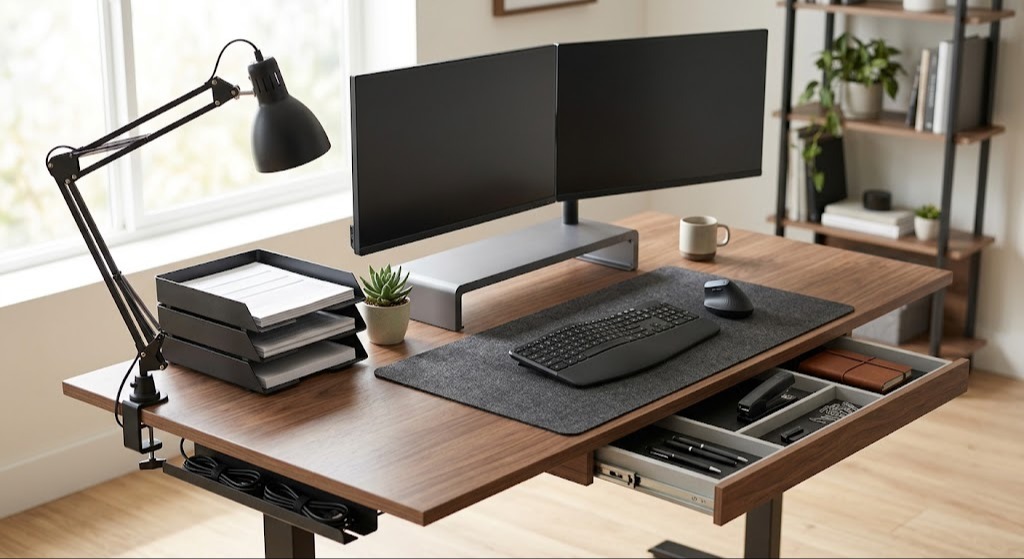
Office desk essentials are the physical tools, ergonomic supports, and organizational hardware curated to eliminate physical friction, reduce cognitive load, and maximize productivity in a workspace. Incorporating high-quality items like adjustable monitor arms, task lighting, and tactile desk mats establishes a structured environment optimized for long-duration deep work.
Key Facts / At a Glance
- Ergonomic Alignment: Placing the top third of a monitor at eye level ($50\text{–}70\text{ cm}$ focal distance) reduces cervical spine torque by up to 40%.
- Workspace Zoning: Dividing the desk into three anthropometric reach zones (Primary: $25\text{–}35\text{ cm}$, Secondary: $35\text{–}50\text{ cm}$, Tertiary: $50\text{–}75\text{ cm}$) minimizes unnecessary shoulder abduction.
- Illumination Metrics: Task lighting requires a minimum illuminance of 500 lux with a Color Rendering Index (CRI) above 95 to prevent visual fatigue.
- Cable Tension Protocol: Sit-stand desk cable management requires a travel-slack safety margin equal to total desk height range plus $15\text{ cm}$ of strain relief.
- Surface Materials: Merino wool felt provides acoustic absorption (NRC $\approx 0.25$), whereas top-grain leather offers total liquid resistance and superior mouse tracking precision.
What Are Office Desk Essentials and How Do They Work?
Office desk essentials are tactile, technical, and structural components arranged on a workspace surface to support body mechanics and cognitive processes. Rather than serving as passive decoration, every essential item acts as an interface between the user, their hardware, and their task environment.
The Friction-Reduction Mechanism
Every physical obstacle in a workspace creates micro-distractions. Searching for an out-of-reach pen, squinting under low illumination, or readjusting a low monitor diverts executive focus from primary tasks. High-grade desk essentials standardize the workspace environment, shifting mechanical interactions from conscious effort to automatic habit.
By stabilizing physical posture and streamlining cable connections, an optimized desk layout preserves mental energy for deep cognitive work.
The 4-Stage Workspace Workflow Cycle
A workspace functions as an integrated ecosystem operating across four sequential operational stages:
- Input and Capture: Physical interfaces—such as mechanical keyboards, vertical mice, and analog note pads—translate immediate cognitive output into digital or physical artifacts.
- Processing and Display: Displays, laptop stands, and color-accurate task lights present information clearly without straining the eyes or neck.
- Organization and Boundaries: Desk mats, cable raceways, and tray systems define distinct physical work zones, keeping peripheral tools organized.
- Maintenance and Power Distribution: High-wattage GaN chargers, surge protectors, and cleaning materials maintain stable system operation over long working sessions.
How Do You Build an Ergonomic Desk Setup Step-by-Step?
Building an ergonomic desk setup requires an inside-out approach starting with seat elevation, moving through display height and peripheral positioning, and ending with environmental lighting and accessory zoning. Following this sequence prevents postural compensations and physical strain over long working sessions.
Step 1: Calibrate Chair and Desk Elevation
Set your chair height so that both feet rest flat on the floor with knees bent at a $90^\circ$ angle. Next, adjust your desk surface height so your arms rest comfortably on the desktop with elbows bent at $90^\circ\text{–}100^\circ$ and shoulders relaxed. If your desk height is fixed and too high, raise your chair and insert a firm footrest to maintain flat leg support.
Step 2: Align Primary Screen and Focal Distance
Position your primary monitor directly in front of your nose, approximately an arm’s length away ($50\text{–}70\text{ cm}$). Elevate the monitor so that the top edge or upper third of the screen aligns horizontally with your direct eye line.
For curved ultrawide monitors ($1000\text{R}\text{–}1800\text{R}$ curvature), adjust the center of the display slightly closer so the screen edges sit equidistant from your eyes, eliminating constant refocusing.
Step 3: Position Input Devices for Neutral Wrists
Place your keyboard and mouse side-by-side where your forearms rest comfortably on the desk surface. Keep your wrist joint flat and straight, avoiding upward or sideways bending while typing or navigating.
If using a mechanical keyboard with a high front lip, place an ergonomic wrist rest directly in front of the board to prevent wrist extension.
Step 4: Layer Task Lighting and Eliminate Glare
Position task lighting to illuminate documents without casting harsh reflections onto your screen. Place swing-arm lamps on the side opposite your dominant writing hand to keep your hand from casting shadows on paperwork.
When using a monitor-mounted light bar, adjust its angle so the cutoff line falls cleanly behind your screen edge, illuminating the desk surface without shining directly into your eyes.
Step 5: Map Accessories to Anthropometric Reach Zones
Organize desk tools according to how frequently you use them, using three distinct reach radii measured from your body position (aligned with ISO 9241-5 standards):
- Primary Reach Zone ($25\text{–}35\text{ cm}$): High-frequency items used continuously without extending your elbows (keyboards, mice, trackpads, active notebooks).
- Secondary Reach Zone ($35\text{–}50\text{ cm}$): Items reached by extending your forearms without leaning your torso (desk phone, coffee mug, reference pens, stream controller).
- Tertiary Reach Zone ($50\text{–}75\text{ cm}$): Low-frequency or background items reached by leaning forward (webcams, head phone stands, ambient speakers, file folders).
What Are the Primary Categories of Office Desk Essentials?
Office desk essentials span six core categories: desk surface protection, task lighting, ergonomic input devices, device elevation, power management, and cable organization. Balancing these categories ensures physical comfort, visual clarity, and electrical safety.
| Category | Primary Hardware Options | Baseline Technical Metrics & Specifications | Typical Price Range |
| Desk Surface Pads | Merino Wool Felt, Top-Grain Leather, Natural Cork, PU Leather | Standard Dimensions: $800 \times 300\text{ mm}$ to $900 \times 400\text{ mm}$. Thickness: $2\text{–}5\text{ mm}$. Noise Dampening: $\text{NRC } 0.20\text{–}0.30$. | $20 – $120 |
| Task Lighting | Asymmetric Screenbars, Balance-Arm Desk Lamps, Ambient Backlights | Illuminance: $500\text{–}1000\text{ lux}$. Color Temp: $2700\text{–}6500\text{ K}$. Color Rendering Index: $\text{CRI } \ge 95$ ($\text{R9 } \ge 80$). | $40 – $200 |
| Ergonomic Inputs | Split Mechanical Keyboards, Vertical Ergonomic Mice, Precision Trackballs | Mouse Sensor Resolution: $1000\text{–}4000\text{ DPI}$. Key Switches: Hot-swappable Mechanical vs. Scissors Membrane. | $60 – $300 |
| Device Elevation | Gas-Spring Monitor Arms, Wooden Riser Stands, Folding Aluminum Laptop Racks | VESA Compatibility: $75 \times 75\text{ mm} / 100 \times 100\text{ mm}$. Weight Load: $2\text{–}15\text{ kg}$. Tilt Range: $-15^\circ \text{ to } +75^\circ$. | $30 – $250 |
| Power Distribution | Desktop GaN Power Stations, Under-Desk Surge Strips, USB-C PD Docks | Power Delivery Output: $100\text{–}240\text{ W}$ (USB-C PD 3.1). Pass-through Bandwidth: $10\text{–}40\text{ Gbps}$ (Thunderbolt 4 / USB4). | $45 – $220 |
| Cable Management | Powder-Coated Steel Trays, Magnetic Neodymium Clips, Braided Sleeves | Tray Length: $400\text{–}600\text{ mm}$. Magnet Grade: N52 Neodymium. Cable Capacity: 8–15 individual lines. | $15 – $65 |
Which Workspace Accessories Should You Choose? Key Category Trade-Offs
Choosing workspace accessories depends on your primary task demands, lighting environment, and maintenance preferences. Evaluating items by material durability, space efficiency, and ergonomic flexibility reveals the optimal trade-offs for your workflow.
Screenbars vs. Traditional Architect Desk Lamps
Asymmetric Screenbars (Monitor Mounted)
- Pros: Screencast lighting units mount directly to your monitor bezel, taking up zero desk surface area. Their asymmetric optical lenses focus light straight down onto your work area without reflecting off glossy screen panels.
- Cons: Light coverage is restricted to the immediate front of your screen, making them less suitable for large physical sketchbooks placed off to the side. They may also block webcams or fail to clamp securely onto curved or ultra-thin displays.
Traditional Architect Swing-Arm Lamps
- Pros: Highly adjustable, multi-joint arms allow you to position light precisely where you need it across a large workspace. They easily illuminate wide paper documents and can swing away when not in use.
- Cons: Heavy bases take up valuable desk space, and improper positioning can cast intense glare across your monitor screen, leading to eye strain.
Felt Mats vs. Top-Grain Leather vs. PU Leather
Merino Wool Felt
- Pros: Natural felt provides exceptional acoustic dampening ($\text{NRC } \approx 0.25$), absorbing high-frequency typing sounds. Its soft texture feels comfortable under wrists and adds visual warmth to a workspace.
- Cons: Felt is highly porous and vulnerable to permanent stains from coffee or ink. Over time, mouse movement across felt fibers can cause pilling, which increases sliding resistance.
Top-Grain Leather
- Pros: Premium leather is exceptionally durable, developing a rich patina over years of use without cracking. Its smooth surface cleans easily with a damp cloth and provides consistent tracking for optical mice.
- Cons: Genuine leather desk pads require a higher initial investment and can feel cool to the touch in cold rooms or sticky during humid summer months.
Polyurethane (PU) Synthetic Leather
- Pros: PU leather offers a budget-friendly, non-porous surface that resists liquids and wipes clean instantly.
- Cons: Synthetic leather degrades faster than natural leather, peeling or cracking at the edges within 12–24 months of heavy daily use.
Monitor Arms vs. Static Wooden Desk Risers
Dynamic Gas-Spring Monitor Arms
- Pros: Monitor arms offer precise, fluid control over screen height, depth, and tilt angle without requiring tools. Elevating the display on a slim pole opens up significant desk area beneath the screen.
- Cons: Monitor arms require a stable desk edge with sufficient clamp clearance ($20\text{–}60\text{ mm}$) and cannot be mounted to thin glass tops or desks with rear privacy skirts.
Static Wooden Desk Risers
- Pros: Wooden shelf risers offer stable, simple screen elevation while creating structured storage compartments underneath for notebooks, audio interfaces, or keyboards.
- Cons: Risers offer fixed, non-adjustable heights. Achieving a truly neutral eye level often requires adding supplementary shims or choosing display-height adapters.
How Do You Wire a Desk for Clean Power and Zero Clutter?
Wiring a desk for clean power requires consolidating all device cables into an under-desk cable tray fed by a single centralized power strip or GaN charger. Leaving sufficient cable slack near the desk spine ensures seamless vertical movement on sit-stand desks without port strain.
Single-Cable Docking and GaN Power Topology
- Mount a multi-socket surge protector and a Gallium Nitride (GaN) desktop charger inside an under-desk cable tray using heavy-duty hook-and-loop fasteners or screws.
- Connect your monitor, desk lighting, and desktop accessories directly into this under-desk power hub.
- Run a single high-bandwidth USB4 or Thunderbolt 4 cable up through a desk grommet to power your laptop ($100\text{–}140\text{ W}$ delivery) and carry video signals to your screen simultaneously.
Under-Desk Tray Routing and Cable Travel Slack
- J-Channel Raceways: Adhere J-channel cable conduits along the underside rear edge of your desk to enclose loose display and power cables.
- Magnetic Cable Clips: Attach N52 magnetic clips along the desk frame or legs to route remaining cords cleanly down out of sight.
- Standing Desk Travel-Slack Margin: When managing cables on a sit-stand desk, raise the surface to its maximum standing height before securing any wires. Ensure the main power cord hanging from the desk to the wall outlet has at least $15\text{ cm}$ of strain-relief slack to prevent cords from tearing loose during desk movement.
$$\text{Minimum Cable Length} = \text{Maximum Standing Height} + 15\text{ cm Strain Relief}$$
What Common Desk Setup Mistakes Ruin Productivity?
Common desk setup mistakes include buying excessive organizational containers that invite clutter, leaving insufficient cable slack on standing desks, and using improper monitor heights that induce neck flexion. Resolving these issues restores ergonomic alignment and eliminates daily operational friction.
The Clutter Creep Fallacy
Adding excess pencil cups, stacking trays, and decorative bins often creates more visual clutter rather than solving an organization problem. Adding containers invites you to accumulate unnecessary items on your desk surface over time.
- The Fix: Enforce a strict “one-in, one-out” rule for all desktop items, and clear your active work area completely at the end of every week. Keep only daily primary tools in your main reach zone.
Standing Desk Cable Strain and Port Snagging
Routing cables tightly while a adjustable desk is lowered often causes cords to pull taut when the desk is raised. This strain can bend connector pins or tear ports directly out of expensive laptops and monitors.
- The Fix: Always adjust, route, and tie your cables with your standing desk raised to its absolute highest setting. Verify that every cable hangs with a smooth curve before lowering the frame back down.
Suboptimal Lighting Lux and Circadian Misalignment
Using a fixed, harsh cold light ($6500\text{ K}$) late in the evening suppresses melatonin production, disrupting your sleep cycle. Conversely, using overly dim lighting ($<300\text{ lux}$) during daytime focus work causes visual fatigue and drowsiness.
- The Fix: Choose task lighting that offers adjustable color temperatures ($2700\text{–}6500\text{ K}$) and dimmable illuminance. Use warm light ($2700\text{–}3000\text{ K}$) for late-night sessions, and shift to bright daylight white ($4000\text{–}5000\text{ K}$) during peak morning working hours.
How Should You Customize Desk Essentials by Role?
Customizing desk essentials by role requires tailoring your equipment to match the specific cognitive, tactile, and visual demands of your daily work. Engineers require multi-monitor support and acoustic dampening, designers need color-accurate lighting, and hybrid workers prioritize modular portability.
The Deep-Focus Software Engineer
Priority
Physical comfort during long typing sessions, minimal visual noise, and sound dampening.
Optimized Configuration
- Input: Split mechanical keyboard paired with a precision trackball or vertical mouse to minimize wrist forearm rotation.
- Surface: Thick $5\text{ mm}$ Merino wool felt desk mat to absorb key-clack resonance and dampen desktop vibrations.
- Display & Light: Heavy-duty dual gas-spring monitor arm supporting vertical and horizontal displays, topped with an asymmetric $4000\text{ K}$ screenbar.
The Creative Visual Designer
Priority
Color accuracy, wide spatial range for tablet drafting, and fluid mouse motion.
Optimized Configuration
- Input: Smooth top-grain leather desk pad paired with a high-DPI laser mouse for precise cursor control across large canvases.
- Lighting: High-CRI ($\text{CRI } \ge 98, \text{R9 } \ge 90$) swing-arm draft lamp that renders physical color proofs and paper sketches accurately without color distortion.
- Display & Accessories: VESA-mounted 27-inch or 32-inch 4K color-calibrated display with an off-desk tablet holder and media control knob.
The Hybrid Corporate Professional
Priority
Fast setup, compact portability, and clear audio-visual framing for frequent video calls.
Optimized Configuration
- Surface & Stand: Rollable, dual-sided PU leather desk mat paired with a lightweight, folding aluminum laptop stand that packs away quickly into a backpack.
- Power & Connectivity: Compact 65W–100W multi-port GaN charger paired with a multi-port USB-C hub.
- AV Essentials: Portable 1080p/60fps webcam with a built-in privacy shutter, paired with compact noise-canceling wireless earbuds.
Frequently Asked Questions About Office Desk Essentials
What is the single most important office desk essential to buy first?
An adjustable monitor arm or riser stand is the most important initial upgrade. Correcting screen height immediately aligns your head, neck, and upper back, preventing slouching and reducing spine strain far more effectively than secondary accessories.
How do you prevent cord clutter on a sit-stand desk?
To prevent cord clutter on a sit-stand desk, consolidate all power plugs into a single surge protector mounted directly inside an under-desk tray. Run only one main extension cord from the desk down to the wall outlet, leaving enough slack for the desk to raise fully without strain.
Are screenbar monitor lights worth it compared to regular lamps?
Screenbar light bars are worth the investment for setups with limited space or reflective monitor displays. By mounting to your screen bezel and directing light down using an asymmetric beam, they illuminate your workspace clearly without taking up desk space or creating screen glare.
What is the ideal color temperature for desk task lighting?
The ideal color temperature for task lighting ranges from $4000\text{ K}$ to $5000\text{ K}$ during daylight hours to promote alertness and concentration. In the late afternoon and evening, lower the color temperature to $2700\text{ K}\text{–}3000\text{ K}$ to protect your sleep cycle and reduce eye fatigue.
How do desk pads affect mouse tracking and acoustic dampening?
Desk pads create a stable surface that improves optical mouse tracking accuracy while protecting your desk top from scratches. Felt pads absorb key-clack sound frequencies, whereas leather and PU leather pads provide smooth surface gliding and easy cleanup.
Conclusion: Optimizing Your Workspace with Office Desk Essentials
Equipping your workspace with high-quality office desk essentials turns a simple table into an ergonomic, high-performance environment. By choosing tools that align with your daily tasks, managing cables cleanly, and setting correct screen heights, you build a supportive workspace that minimizes physical strain and eliminates daily friction.
Focus first on foundational ergonomics—such as monitor elevation and task lighting—before selecting secondary tools like desk mats and organizers. Updating your desk essentials creates an organized, inviting environment built for comfortable focus and long-term productivity.