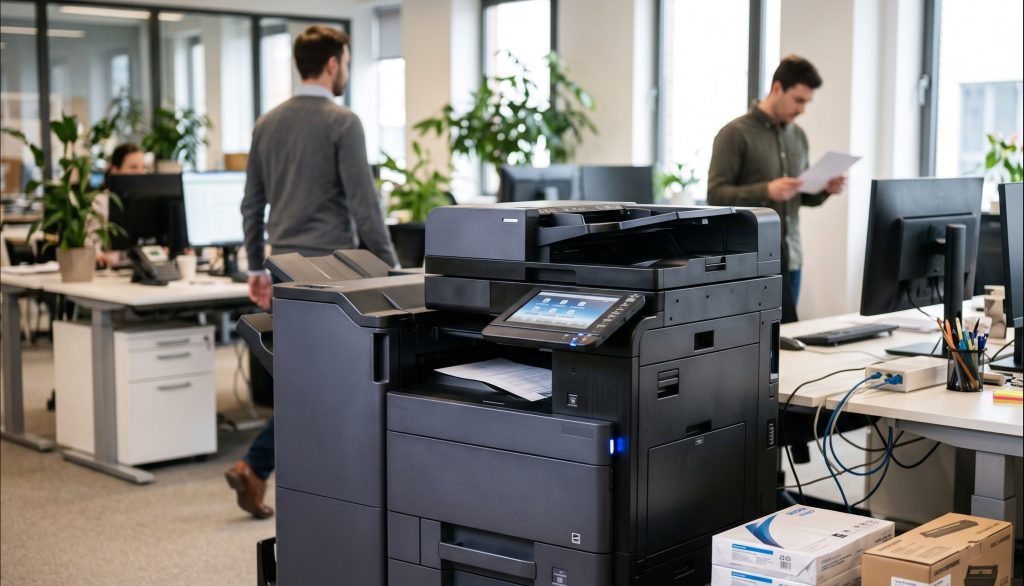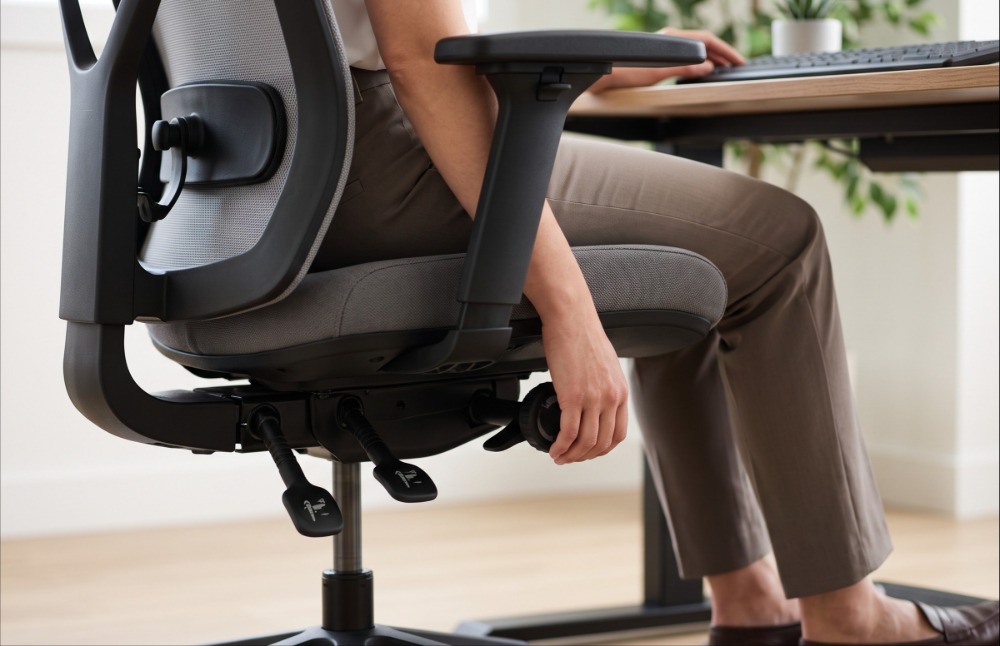
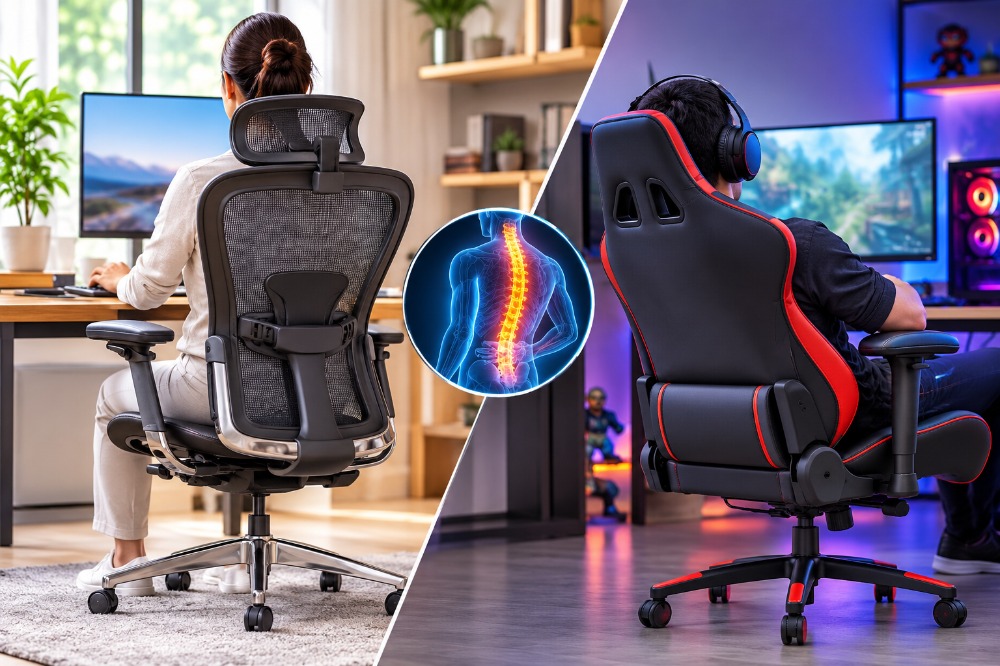
When choosing between an office chair vs gaming chair, an ergonomic office chair is the superior investment for anyone sitting upright at a keyboard for more than 4 hours daily. It wins because synchronous 2:1 tilt mechanics, sliding seat pans, and 12-year commercial warranties prevent lumbar disc compression and outlast racing chairs by a decade. Buy a racing-style gaming chair only if you recline past 135 degrees with a controller, require a built-in neck rest for media lounging, or prefer firm 55+ kg/m³ cold-cured foam with a high-back aesthetic.
Quick Verdict by User Profile
- For 8+ Hour WFH & PC Gaming: Ergonomic Office Chair (Herman Miller Aeron, Steelcase Leap V2, or Haworth Soji) for dynamic spinal tracking and zero thigh compression.
- For Reclined Controller Play & Lounging: Fabric Racing Gaming Chair (Secretlab Titan Evo SoftWeave Plus or Razer Iskur V2) for 165° lockable recline and cervical head support.
- For Budgets Under $300: Refurbished Commercial Office Chair (used Steelcase Amia) or Budget Ergonomic Mesh (Colamy Atlas); sub-$250 PU-leather gaming chairs peel and flatten within 18 months.
- For Cross-Legged Sitters: Frameless Foam Office Chair (Steelcase Leap V2 or Haworth Fern); avoid gaming bucket bolsters and rigid-rimmed mesh seats.
- For Petite (<5’3″) or Heavy (>275 lbs) Users: Size-Scaled Chairs (Herman Miller Aeron Size A/C or Secretlab Titan Evo Small/XL) to match femur length and gas lift limits.
Master Comparison: Office Chair vs Gaming Chair Specifications
| Decision Criterion | Ergonomic Office Chair (Commercial Standard) | Racing-Style Gaming Chair (Standard & Premium) | Category Winner |
| Primary Posture Target | Upright typing to micro-reclined tasking (90°–125°) | Rigid upright to deep couch-style lounging (90°–180°) | Office Chair (for desk work) |
| Tilt Mechanism | Synchronous tilt (2:1 or 2.5:1 backrest-to-seat ratio) | Single-pivot center/frog tilt + independent car-seat lever | Office Chair |
| Lumbar Architecture | Integrated depth/height adjustment or self-adjusting suspension | Strap-on memory foam pillow (budget) or 4-way internal cam (premium) | Office Chair |
| Seat Depth Adjustment | 2.0″ to 3.5″ horizontal sliding seat pan standard on mid/high tiers | Fixed seat depth across 98% of models (no seat slider) | Office Chair |
| Seat Cushion Density | 30 kg/m³ (budget cut foam) to 55 kg/m³ (commercial molded) or Pellicle mesh | 50 to 65 kg/m³ dense cold-cured injected molded foam | Tie (Mesh for cooling; 60 kg/m³ for firmness) |
| Daily Usage Rating | 8 to 24 consecutive hours (ANSI/BIFMA X5.1 certified) | 6 to 8 hours before bolster pressure or heat builds up | Office Chair |
| Gas Lift Cylinder | Class 4 heavy-duty (supports 300–400 lbs); Class 3 on sub-$180 units | Class 4 on $300+ models (290–395 lbs); Class 3 on budget (<250 lbs) | Tie (Both use Class 4 at $300+) |
| Price Tiers (New) | Entry: $150–$350 | Mid: $400–$850 | Premium: $900–$1,800+ | Entry: $100–$250 | Mid: $300–$600 | Premium: $650–$1,200+ | Gaming Chair (Lower upfront sticker) |
| Warranty Coverage | 5 to 12 years (bumper-to-bumper: pneumatics, textiles, mechanisms) | 2 to 5 years (often excludes PU leather peeling and armrest pads) | Office Chair |
| Expected Lifespan | 7 to 15+ years (replaceable wear parts) | 2 to 6 years (hydrolysis degrades faux leather in 24–36 months) | Office Chair |
| 10-Year Net Cost (TCO) | ~$45–$85/year (after 45% resale value or zero replacements) | ~$110–$160/year (requires 2–3 full chair purchases over 10 years) | Office Chair |
1. Spinal Mechanics, Tilt Systems, and Lumbar Architecture
An ergonomic office chair is engineered around dynamic micro-movements, whereas a racing gaming chair is built around static structural containment.
When you lean back in an ergonomic office chair like the Steelcase Leap V2 ($1,395 new / $550 refurbished) or Haworth Soji ($550), the chair engages a synchronous tilt mechanism (typically a 2:1 ratio). For every 2 degrees the backrest reclines, the rear of the seat pan drops by 1 degree. This opens your hip-to-torso angle beyond 100 degrees to reduce intradiscal lumbar pressure without lifting your heels off the floor or pulling your eyes away from your monitor. Furthermore, high-end office chairs offer forward seat tilt (-5 degrees), rotating the pelvis forward during intense keyboard typing to maintain a natural lordotic curve.
In contrast, racing-style gaming chairs adapt automotive bucket seats designed to brace drivers against lateral G-forces on a racetrack—a force that does not exist at a desk. Their mechanical core relies on two separate levers: an automotive-style ratcheting recline lever that drops the backrest between 135° and 180°, and a basic single-pivot center tilt (or multi-tilt “frog” mechanism) beneath the seat. When you engage a standard center tilt on a gaming chair, the front edge of the seat pan rises upward, pressing into the underside of your thighs and cutting off blood flow unless your feet leave the floor.
Correction to Common Myths on Lumbar Support: While entry-level and mid-range gaming chairs ($100–$350, like standard DXRacer or GTPlayer models) still rely on external, strap-on memory foam pillows that flatten within 6 months and push the spine out of alignment, flagship gaming chairs have evolved. Models like the Secretlab Titan Evo ($549–$624) and Razer Iskur V2 ($649) now feature internal 4-way mechanical lumbar systems controlled by side dials. Even with these upgrades, gaming chair backrests remain flat, rigid steel frames with forward-curving shoulder “wings” that can force broad-shouldered users (>19″ biacromial breadth) into a thoracic slouch. Office chairs like the Herman Miller Aeron (with PostureFit SL sacral/lumbar pads) or Logitech Embody ($1,695, featuring a pixelated flexible polymer spine) flex torsionally when you reach to the side.
Criterion Verdict: Ergonomic office chairs win for spinal health because 2:1 synchronous tilt and flexible backrests support dynamic posture without compressing the thighs, whereas gaming chairs win only when locked past 135 degrees for reclined relaxation.
2. Seat Pan Geometry, Foam Density, and Popliteal Clearance
The seat pan determines whether your lower extremities go numb after three hours of sitting. The decisive difference here is bucket bolstering vs. waterfall edges with seat sliders.
- Seat Depth Adjustability (Popliteal Clearance): Proper ergonomics requires a 2-to-3 finger gap (1.5 to 2 inches) between the front edge of the seat and the back of your knees (the popliteal fold). Nearly every mid-to-premium office chair features a sliding seat pan offering 2.0 to 3.5 inches of horizontal travel (generally adjusting from 15.5″ to 18.5″ in depth). Almost no racing gaming chairs include a seat slider; they use a fixed seat pan depth (typically 18.5″ to 19.5″), forcing users under 5’7″ to either give up lower back contact or let the seat edge dig into their calves.
- Side Bolsters vs. Flat/Waterfall Contours: Racing gaming chairs weld steel framing tubes along the left and right edges of the seat pan, wrapping them in angled foam bolsters that rise 2 to 3.5 inches high. If you have wide hips, muscular thighs, or sit with your knees spread, these bolsters create painful lateral pressure points against the iliotibial (IT) band. Office chairs use flat or gently contoured pans with a downward-sloping waterfall front edge that eliminates thigh compression.
- Foam Density Physics (kg/m³): Budget office chairs ($150–$250) often commit the “Plush Comfort” trap, using soft 30 to 35 kg/m³ cut polyurethane foam. It feels luxurious for five minutes, then compresses completely (“bottoms out”) after 60 minutes, allowing your ischial tuberosities (sit bones) to hit the plywood or plastic baseplate. Gaming chairs generally use 50 to 65 kg/m³ cold-cured molded foam—which feels shockingly firm out of the box, resists deformation for 6–8 hours, and provides a stable base, though it does not conform organically like high-end office tensioned elastomer mesh (e.g., Herman Miller’s 8Z Pellicle mesh, which divides the seat into 8 distinct tension zones) or commercial 50–55 kg/m³ multi-layered office foam.
Criterion Verdict: Ergonomic office chairs win because sliding seat pans and waterfall edges accommodate varied femur lengths and sitting postures, while gaming chair side bolsters restrict leg placement.
3. 10-Year Total Cost of Ownership (TCO), Warranty, and Resale Value
Looking solely at retail sticker prices masks the true financial math of the office chair vs gaming chair decision. While entry-level gaming chairs start lower ($100–$250 vs. $150–$350 for office chairs), their rapid material degradation flips the long-term cost equation.
| Financial Metric | Budget Gaming Chair (e.g., $200 Amazon Racer) | Premium Gaming Chair (e.g., $550 Secretlab Titan Evo) | Mid-Range Office Chair (e.g., $550 Haworth Soji) | Remanufactured Flagship Office (e.g., $600 Steelcase Leap V2) | New Flagship Office Chair (e.g., $1,450 Herman Miller Aeron) |
| Upfront Purchase Cost | $200 | $550 | $550 | $600 (Retail: $1,395) | $1,450 |
| Warranty Coverage | 1–2 Years (Parts limited) | 3–5 Years | 12 Years (24/7 commercial) | 12 Years (via Crandall/BTOD) | 12 Years (24/7, 3-shift labor incl.) |
| Average Functional Lifespan | 1.5–2.5 Years | 5–6 Years | 10–12 Years | 12–15 Years | 15–20 Years |
| Units Needed Over 10 Years | 4 to 5 Chairs | 2 Chairs | 1 Chair | 1 Chair | 1 Chair |
| Est. Resale Value at Year 10 | $0 | $50–$75 | $100–$150 | $250–$300 | $500–$650 |
| 10-Year Net Cost | $800–$1,000 | $1,025–$1,050 | $400–$450 | $300–$350 | $800–$950 |
| True Cost Per Year | $80–$100/yr | $102–$105/yr | $40–$45/yr | $30–$35/yr | $80–$95/yr |
Furthermore, commercial office furniture enjoys a massive secondary liquid market. When corporate offices liquidate, dealers refurbish Grade-A chairs like the Steelcase Amia, Leap V2, and Herman Miller Aeron with fresh 55 kg/m³ foam and new Class 4 cylinders, selling them for $400 to $650—the exact price of a mid-range gaming chair. When a commercial office chair breaks under its 12-year warranty, the manufacturer dispatches a certified technician to your home at zero cost. Gaming chair warranties (2 to 5 years) typically ship you a replacement part and require you to disassemble the chair yourself.
Criterion Verdict: Ergonomic office chairs win decisively on 10-year total cost of ownership, costing 50% to 70% less per year of use when factoring in durability, 12-year warranties, and resale liquidity.
4. Thermal Regulation and Upholstery Longevity
Skin contact temperature rises by 3°C to 5°C (5.4°F to 9°F) over a 4-hour sitting session on non-breathable surfaces.
- Polyurethane (PU) Faux Leather (Standard Gaming & Executive Office): 75% of racing gaming chairs and traditional executive high-back office chairs use PVC or PU leather bonded to a textile backing. It is non-porous, trapping body heat and sweat. Worse, human sweat contains salts and lactic acid that trigger hydrolysis—a chemical breakdown of polyurethane bonds. Without bi-weekly conditioning, standard PU leather cracks, bubbles, and flakes into black crumbs within 24 to 36 months.
- 3D Knit Fabrics & Hybrid Leatherettes (Modern Gaming & Foam Office): Premium gaming brands now offer breathable tightly woven polyester knits (e.g., Secretlab SoftWeave Plus or Corsair Luxe Weave) and solvent-free hybrid leatherettes graded for 12 to 15x higher abrasion resistance (50,000 to 100,000+ Martindale rub cycles). While far more durable than cheap PU, thick 60 kg/m³ foam beneath fabric still acts as a thermal insulator in rooms above 74°F (23°C).
- Suspension Elastomer Mesh (Ergonomic Office): Mesh chairs like the Herman Miller Aeron, Branch Verve, or ErgoChair Pro suspend the user over open air. Heat dissipates immediately via ambient airflow, keeping skin temperatures near room baseline. High-grade elastomeric mesh passes 100,000+ double-rub Wyzenbeek abrasion tests without sagging, though cheap sub-$150 nylon mesh can stretch out after 3 years and abrade delicate clothing (like wool trousers).
Criterion Verdict: Ergonomic mesh office chairs win in warm climates and for hot sleepers due to unobstructed 360-degree airflow, while 3D knit fabric chairs take second place for users who prefer padded cushioning.
5. Armrest Kinematics and Desk Integration
Armrests carry roughly 10% to 12% of your body weight; if they sit too wide or too high, your trapezius muscles stay chronically contracted or you hunch forward away from the backrest.
- 3D vs. 4D Adjustability Range: Both mid-tier gaming chairs and ergonomic office chairs advertise “4D armrests” (adjusting in height, depth, width, and pivot angle). However, the minimum internal width between the pads differs sharply. Because racing chairs have wide bucket seats, their armrests are often mounted 19.5 to 21.5 inches apart. Narrow-framed users cannot bring the pads close enough to support their elbows while typing on a compact 60% or TKL keyboard. High-end office chairs like the Steelcase Gesture feature double-articulating arms that sweep inward to a narrow 10.5-inch internal gap (ideal for mobile phone use or compact typing) and drop down to 6.5 inches above the seat pan to slide cleanly under low keyboard trays.
- Synchronized Arm Tracking: On standard gaming chairs and many mesh office chairs, the armrests attach to the underside of the seat pan. When you recline the backrest to 135 degrees, the armrests stay flat and forward, leaving your elbows hanging in the air. Chairs like the Steelcase Leap V2 and Haworth Fern attach their armrests directly to the backrest spine mechanism so the pads tilt seamlessly with your torso.
Criterion Verdict: Ergonomic office chairs win because narrower inward pivot clearances and backrest-linked tracking keep elbows supported across both typing and reclined postures.
6. Build Standards (ANSI/BIFMA X5.1), Maintenance, and Failure Points
In commercial seating, durability is governed by ANSI/BIFMA X5.1 (US) and EN 1335 (Europe). To pass ANSI/BIFMA X5.1, a complete chair—not just a single sub-component—must survive brutal laboratory stress tests: a 225-to-300 lb free-fall drop onto the seat, 100,000 to 300,000 cyclic backrest tilts, and 120,000 caster roll cycles over obstacles.
Watch Out for the “BIFMA/SGS” Marketing Loophole: Nearly every $150 gaming chair on Amazon claims “BIFMA Certified” or “SGS Certified.” In 90% of budget listings, that certificate applies only to the $12 Class 3 or Class 4 gas lift cylinder, not the plywood seat base, weld points, or tilt mechanism. True commercial office chairs test the entire assembled unit.
Common Mechanical Failures and DIY Fixes
Whether you own an office or gaming chair, three mechanical failures account for 85% of user complaints:
- Sinking Seat Syndrome (Failed Pneumatic Seal): When internal nitrogen gas bypasses the worn rubber O-ring inside the cylinder, the chair drops slowly under load. The Fix: Skip plastic clip-on shaft spacers, which ruin height adjustability. Use a 14-inch heavy-duty pipe wrench to twist the old cylinder free from the mechanism, knock it out of the 5-star wheelbase with a rubber mallet, and drop in a universal Class 4 heavy-duty replacement cylinder ($20–$30 online) rated for 350–400 lbs.
- Tilt-Box Squeaking (Spring Housing Friction): Metal-on-metal creaking when leaning back originates inside the central tension spring block beneath the seat pan. The Fix: Invert the chair, unscrew the plastic housing shroud, and apply white lithium grease or heavy-duty silicone spray directly onto the main coil spring and pivot bushings. Never use standard penetrative WD-40; its solvent carrier evaporates quickly and strips existing factory grease, making the squeak worse within two weeks.
- Peeling Polyurethane & Hard Floor Damage: Once PU leather starts flaking, it cannot be reversed. The Fix: Wipe non-peeling PU leather bi-weekly with a damp microfiber cloth and apply a water-based UV/faux-leather conditioner; if flaking has begun, install a stretch-spandex slipcover. For hardwood or laminate floors, immediately swap out stock hard black nylon casters for $25 rollerblade-style polyurethane casters (standard 11mm x 22mm stem, except for IKEA chairs which require 10mm stems) to eliminate floor scratches without needing a plastic floor mat.
Criterion Verdict: Ergonomic office chairs win on structural integrity because whole-chair ANSI/BIFMA X5.1 compliance and modular parts prevent the weld cracks and upholstery failures common in budget gaming chairs.
Which Should You Choose? Recommendations by User Persona
1. The 9-to-5 Remote Professional & Hybrid PC Gamer
- The Winner: Ergonomic Office Chair (Mid-Range: Haworth Soji at ~$550; Refurbished Flagship: Steelcase Leap V2 at ~$600; New Flagship: Herman Miller Aeron at ~$1,450).
- Why: Sitting 8 to 12 hours across Zoom calls, spreadsheets, and evening mouse-and-keyboard gaming demands active pelvic support, a 2:1 synchro-tilt mechanism, and a sliding seat pan. Your forearms remain level with the desk during rapid mouse tracking, and your lower back avoids static fatigue.
2. The Reclined Controller Gamer & Media Lounger
- The Winner: Premium Fabric Racing Gaming Chair (Secretlab Titan Evo in SoftWeave Plus at ~$579 or Corsair TC100 Relaxed Fabric at ~$249).
- Why: Standard office chairs stop reclining around 120°–125° and rarely include full-height neck support out of the box (headrests for the Aeron or Leap cost $150–$200 extra from third parties like Atlas). If you lean back to 150°+ with an Xbox/PlayStation controller or watch movies at your desk, a high-backed racing chair with a magnetic memory-foam head pillow and independent backrest lock provides full-spine lounging comfort.
3. The Tight-Budget Buyer (Under $300)
- The Winner: Entry BIFMA Mesh Office Chair (Colamy Atlas at ~$269 or Ticova Ergonomic at ~$160) OR a Used Local Commercial Chair (Facebook Marketplace Steelcase Amia for ~$200).
- Why: The sub-$250 gaming chair bracket is the worst value trap in furniture. At this price, manufacturers cut corners with recycled foam Scraps, thin 1.0mm steel frames, fixed 2D plastic armrests, and cheap PU leather that peels in 14 months. A $200–$270 mesh task chair gives you aluminum or reinforced nylon framing, a sliding seat pan, and breathable upholstery.
4. The Cross-Legged Sitter & Constant Posture Shifter
- The Winner: Frameless Flexible-Edge Office Chair (Steelcase Leap V2, Haworth Fern, or Herman Miller Sayl) — or the Secretlab Titan Evo XL if you prefer a wide, flat foam pad.
- Why: If you tuck one ankle under your thigh or sit cross-legged, two popular designs will hurt you: traditional racing gaming chairs (whose flared steel side bolsters dig into your shins) and the Herman Miller Aeron (whose hard, raised plastic outer perimeter frame bruises ankles). Choose a padded office chair with a flexible, frameless front lip.
5. Petite (<5’3″) or Big & Tall (>6’2″ / 275–390 lbs) Users
- The Winner: Proportionally Scaled Seating (Herman Miller Aeron Size A for <5’3″; Aeron Size C or Secretlab Titan Evo XL for >6’2″ / up to 350–395 lbs).
- Why: Standard “one-size-fits-all” chairs are engineered for a 5’9″, 175 lb male archetype. Petite users need a minimum seat height that drops to 14.5–15.5 inches and a shallow 15.5-inch seat depth (Aeron Size A) so their feet touch the floor without a footrest. Heavy users over 275 lbs require a wide 21″+ seat base, a heavy-duty Class 4 cylinder, and either Size C 8Z Pellicle mesh or 60 kg/m³ cold-cured foam (Titan Evo XL) so the cushion never bottoms out.
Honest Limitations: What Neither Side Tells You
- Where Ergonomic Office Chairs Disappoint: Most ergonomic office chairs are terrible for napping or kicking back. Their backrests terminate below the shoulder blades or neck, requiring expensive aftermarket headrests (like the $189 Atlas Headrest) if you want cervical support. Furthermore, all-mesh seats (like the Aeron or Ergohuman) hold you in a disciplined “ergonomic pocket”—if you like curling up in a ball with a blanket, a mesh office chair feels cold, sterile, and unforgiving.
- When the Gaming Chair Is Genuinely the Better Choice: If you weigh 230+ lbs and hate the bouncy “hammock” sensation of mesh or the thin feel of standard cut foam, the slab-like 55–65 kg/m³ cold-cured foam in a premium gaming chair (like the Secretlab Titan Evo or noblechairs Hero) provides an unyielding, rock-solid platform that will not bottom out for years. Additionally, for streamers and content creators on camera, a monochrome grey office chair lacks visual framing compared to a tailored, high-back silhouette.
- What Nobody in This Market Tells You (The Ergonomic Crossover Tax): Furniture brands noticed gamers abandoning cheap racing buckets and created “Ergonomic Crossover Gaming Chairs”—such as the Herman Miller x Logitech G Embody ($1,695), Herman Miller Vantum ($895), and ASUS ROG Destrier ($899). Be careful: while the Logitech Embody is a world-class ergonomic chair with extra copper-infused cooling foam, many “hybrid gamer mesh” chairs are simply $300 OEM Chinese mesh office chairs wrapped in aggressive plastic shrouds and RGB accents with a $400 gamer markup. Always compare a crossover chair’s mechanism weight and warranty length against its non-gaming office twin before paying for the logo.
Frequently Asked Questions (FAQ)
Are ergonomic crossover gaming chairs worth the price premium over standard office chairs?
Only when built on a proven commercial platform like the Herman Miller x Logitech Embody ($1,695), which adds cooling copper-foam padding to the standard office Embody for the same price, backed by a 12-year warranty. Avoid 2-year-warranty “gamer mesh” crossovers that charge $700+ for basic rebranded $300 task chairs.
Can an ergonomic office chair fix existing lower back pain or sciatica?
An office chair cannot cure underlying disc herniation or sciatica, but a chair with an adjustable seat slider, 2:1 synchro-tilt, and sacral support (like the Steelcase Leap V2 or Aeron) stops seating-induced flare-ups. Still, static sitting compresses spinal discs regardless of chair price; take a 2-minute standing break every 45 minutes.
Why do new gaming chairs feel firmer than office chairs out of the box?
Quality gaming chairs use 50 to 65 kg/m³ cold-cured molded foam, which cures inside an aluminum mold to form a dense outer skin that resists sagging over 5+ years. It requires a 3-to-4 week break-in period, whereas budget office chairs use softer 30–35 kg/m³ cut foam that feels plush immediately but flattens rapidly.
Should I buy a chair with a built-in footrest for reclining?
Skip integrated slide-out footrests. Built-in telescoping footrests mounted on two thin steel rods underneath budget gaming chairs bend easily when weighted and rattle during upright use. Instead, buy a chair with a solid tilt lock and pair it with a standalone $30 under-desk ergonomic foot rocker or padded ottoman.
Is it safe to buy a refurbished commercial office chair instead of a new gaming chair?
Buying a refurbished Steelcase Leap V2, Amia, or Herman Miller Aeron ($400–$650) from reputable remanufacturers like Crandall Office Furniture or BTOD is the highest-value purchase in seating. These sellers strip the chair to its steel frame, install brand-new foam, upholstery, casters, and Class 4 cylinders, and include a 12-year warranty.