
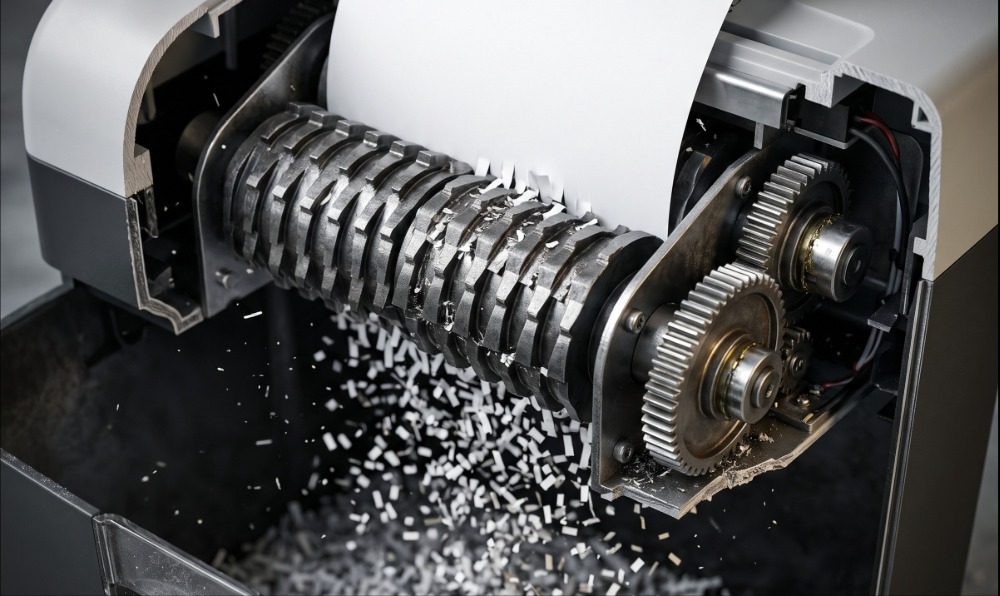
How does a paper shredder work? A paper shredder operates by converting high-speed, low-torque electrical energy from an internal motor into low-speed, high-torque shearing force through a multi-stage gear reduction train. When paper breaks an entry sensor beam, two counter-rotating hardened steel shafts interlock with sub-millimeter tolerances, gripping and shearing documents into unreadable strips or confetti particles.
Key Facts: Paper Shredder Mechanics at a Glance
- Power Conversion: Internal motors spin at 1,700 to 3,300 RPM, which a multi-stage gearbox reduces to 40 to 90 RPM at the cutting shafts to multiply cutting torque by 25x to 60x.
- Sensing Triggers: Feed slots use 850–940 nm infrared optical beams or piezoelectric mechanical micro-switches to activate the motor only when media enters the throat.
- Cutting Geometries: Shredders use three primary blade architectures—Strip-Cut (parallel circular knives), Cross-Cut (helical V-notched teeth), and Micro-Cut (ultra-dense fine-toothed cylinders).
- Security Standards: The international DIN 66399 (ISO/IEC 21964) standard classifies paper destruction across seven levels, from P-1 ($\le 12\text{ mm}$ ribbons) to P-7 ($\le 5\text{ mm}^2$ top-secret dust).
- Thermal Limits: Consumer AC universal motors generate intense heat, restricting continuous operation to 2 to 5 minutes followed by a mandatory 20- to 40-minute thermal cool-down cycle.
What Are the Core Electromechanical Components of a Paper Shredder?
A paper shredder consists of five primary internal sub-assemblies: the drive motor, the speed-reduction gearbox, the counter-rotating cutting cylinders, the stripper combs, and the printed circuit board (PCB) with safety interlocks. Together, these components fit inside the heavy “cutting head” that rests atop the waste collection bin.
| Component | Primary Engineering Function | Typical Material / Specification | Common Failure Mode |
| Electric Drive Motor | Generates initial rotational kinetic energy | AC Brushed Universal (1,700–3,300 RPM) or Brushless Induction (1,400–1,750 RPM) | Thermal winding burn-out or worn carbon brushes |
| Gear Reduction Box | Multiplies torque and drops shaft rotation speed | Polyoxymethylene (Delrin/Nylon) in consumer units; case-hardened steel in commercial units | Stripped gear teeth from overfeeding sheets |
| Cutting Cylinders | Grips and shears paper across an interlocking threshold | Grade 1045 or 4140 carbon steel, hardened to 50–58 HRC | Dulled cutting edges or bent shafts from heavy metal clips |
| Stripper Combs | Scrapes shredded particles out of blade grooves | Stamped steel fingers or rigid injection-molded ABS/nylon | Warped or broken fingers causing internal accordion jams |
| Control Board (PCB) | Regulates sensor signals, motor relays, and timers | Solid-state relays, infrared phototransistors, bimetallic thermal cutouts | Blown fuses or optical sensors blinded by paper dust |
1. The Electric Motor: Universal Brushed vs. Induction Motors
The motor provides the mechanical power required to shear dense cellulose fibers, staples, and polymer credit cards. Shredder manufacturers rely on two distinct motor architectures depending on the target price and duty cycle:
- AC Universal Brushed Motors: Found in 85% of consumer and home-office shredders priced under $150, universal motors use carbon brushes contacting a spinning commutator. They operate at high speeds (1,700 to 3,300 RPM), offer high starting torque in a compact footprint, and cost very little to manufacture. However, brush friction creates 70 to 75 dB of noise, generates rapid heat buildup, and produces tiny electrical commutator sparks inside the motor housing.
- Brushless AC Induction & Permanent Magnet DC Motors: Installed in heavy-duty office and commercial shredders ($250+), induction motors use electromagnetic induction without physical brush contact. They spin slightly slower (1,400 to 1,750 RPM), run quietly at 50 to 58 dB, generate minimal waste heat, and support continuous duty cycles of 60 minutes to 24 hours without thermal shutdowns.
2. The Gear Reduction Train: Multiplying Torque
An electric motor spinning at 3,000 RPM lacks the rotational force (torque) to slice through 10 sheets of stacked 80 gsm bond paper directly. Connecting the motor shaft directly to the blades would stall the motor instantly.
To solve this, the motor spindle drives a multi-stage gear reduction train using spur, helical, or planetary gears. Each gear stage meshes a small pinion gear into a larger driven gear, trading rotational velocity for brute mechanical leverage:
- Reduction Ratio: Most desktop shredders apply a 25:1 to 60:1 gear ratio, stepping a 3,000 RPM motor down to 45 to 90 RPM at the cutting shafts.
- Torque Multiplication: A 40:1 speed reduction multiplies motor torque roughly 40-fold (minus 10% to 15% frictional drivetrain loss), allowing a modest 150-watt to 350-watt motor to exert ratusan pounds of shearing force per square inch at the blade tips.
- Spur vs. Helical Gears: Entry-level shredders use straight-cut spur gears molded from engineering plastics like polyoxymethylene (Delrin) or nylon. Mid-to-high-end shredders use angled helical gears made of sintered metal or hardened steel, which distribute tooth load gradually to prevent gear stripping and reduce mechanical whine.
3. The Cutting Shafts and Interlocking Blades
The gearbox terminates in two parallel, hexagonal or splined drive axles that rotate in opposite directions (contra-rotation) toward the center of the feed throat. Mounted along these axles—or CNC-machined directly out of a solid steel bar in premium German-engineered units like Krug & Priester (EBA/Ideal) or Dahle—are dozens of circular cutting discs.
These hardened steel discs overlap by 1.5 mm to 4.0 mm and maintain a lateral clearance of just 0.02 mm to 0.05 mm between adjacent faces. Because the clearances are tighter than a single sheet of standard copy paper (0.10 mm thick), the paper cannot fold between the blades; it is forced to shear cleanly across the hardened edges.
How Does a Paper Shredder Work Step by Step?
Every time you feed a document into the throat of a shredder, the machine executes a synchronized five-stage electromechanical sequence in less than five seconds.
Step 1: Media Detection (Optical vs. Mechanical Sensors)
When a shredder switch is set to “Auto” (Standby), the motor remains dormant while the PCB monitors a detection sensor positioned inside the center of the feed slot:
- Infrared (IR) Optical Sensors: An infrared light-emitting diode (LED) on one wall of the throat projects an invisible 850 nm to 940 nm light beam across a 4 mm gap to a phototransistor on the opposite wall. Inserting paper blocks the photon stream, causing a voltage drop across the phototransistor.
- Mechanical Lever Switches: Found in budget shredders and preferred in dusty environments, a lightweight metal or plastic wire paddle hangs across the center of the slot. Pushing paper into the throat physically deflects the paddle by 2 to 3 millimeters, depressing a micro-switch contact.
Step 2: Circuit Activation and Inrush Current
Once the sensor state changes, the control board closes a solid-state relay or triac switch, routing mains electricity (120V in North America; 230V in Europe) to the motor windings. During the first 50 to 100 milliseconds, the motor draws an inrush current up to 3 times its normal operating amperage to overcome the static inertia of the gearbox and steel shafts.
Step 3: Self-Feeding Grip and Compression
As the leading edge of the paper stack drops 10 to 15 mm into the throat, it contacts the converging upper curve of the counter-rotating cutting cylinders. On cross-cut and micro-cut models, the serrated V-notches on the blade perimeters act as high-friction mechanical hooks. They bite into the paper fibers, compress trapped air out of the multi-sheet stack, and pull the document downward at a linear feed speed of 6 to 14 feet per minute (1.8 to 4.3 meters per minute) without requiring the user to push.
Step 4: Shearing, Fragmentation, and Stripping
As the paper passes the horizontal centerline connecting the two shafts, the overlapping blades subject the cellulose fibers to simultaneous compressive and shear stress exceeding the tensile strength of paper (~30–40 MPa).
- Longitudinal Slitting: The sharp sidewalls of the rotating discs slice the paper vertically along the length of the page.
- Transverse Chopping (Cross/Micro-Cut only): Angled notches milled into the circumference of each disc meet opposing notches on the mating cylinder like a pair of rotating wire cutters, snapping the vertical ribbons horizontally into finite rectangles.
- Active Stripping: Because tight paper confetti naturally wedges itself into the grooves between spinning blades, fixed U-shaped metal or rigid polymer stripper combs wrap around the bottom half of the shafts. As the blades rotate past these stationary fingers, the combs scrape every fragment off the steel and deflect it downward into the waste bin.
Step 5: Deactivation Delay and Clearing Cycle
The instant the trailing bottom edge of the paper clears the entry sensor in the upper throat, the optical beam reconnects (or the mechanical paddle springs back). However, the trailing 1.5 inches (38 mm) of paper are still traveling through the cutting cylinders below the sensor.
To prevent half-shredded paper from remaining trapped in the teeth, the PCB activates a capacitance or microcontroller delay timer, keeping the motor spinning for an additional 1.5 to 3.0 seconds after sensor clearance before cutting power.
How Does Blade Geometry Determine Cut Type and Security?
The physical shape of the shredded output is governed entirely by the geometry of the cutting cylinders and the presence or absence of transverse cutting teeth.
STRIP-CUT (P-1 to P-2)         CROSS-CUT (P-3 to P-4)         MICRO-CUT (P-5 to P-7)
┌────────────────────┐         ┌────────────────────┐         ┌────────────────────┐
│  │  │  │  │  │  │  │         │ ▭  ▭  ▭  ▭  ▭  ▭  │         │ · · · · · · · · ·  │
│  │  │  │  │  │  │  │         │  ▭  ▭  ▭  ▭  ▭  ▭ │         │ · · · · · · · · ·  │
│  │  │  │  │  │  │  │         │ ▭  ▭  ▭  ▭  ▭  ▭  │         │ · · · · · · · · ·  │
│  │  │  │  │  │  │  │         │  ▭  ▭  ▭  ▭  ▭  ▭ │         │ · · · · · · · · ·  │
└────────────────────┘         └────────────────────┘         └────────────────────┘
Smooth Rotary Knives           Helical Serrated Teeth         Ultra-Fine Micro-Teeth
(~35–50 ribbons/sheet)         (~300–800 pieces/sheet)        (~2,000–15,000 specks/sheet)
1. Strip-Cut (Ribbon-Cut) Mechanism
Strip-cut shredders use flat, smooth-edged circular discs separated by spacer rings, resembling stacked pizza cutters. Because the disc perimeters have no notches, they make continuous 11-inch vertical slits without ever interrupting the cut horizontally.
- Mechanical Advantage: Because the blades only shear along two vertical points per disc at any given millisecond, strip-cut machines require 40% less motor torque, rarely jam, require zero blade oiling, and process 15 to 30+ sheets per pass at speeds up to 20 feet per minute.
- Security Flaw: A single lines-of-text document cut into 39 vertical strips of 6 mm width can be reconstructed by hand in under 45 minutes or via optical scanning software in seconds.
2. Cross-Cut (Confetti-Cut) Mechanism
Cross-cut shredders replace smooth discs with serrated, V-notched cutting wheels arranged in a staggered helical (spiral) pattern across the shaft. If all notches aligned in a straight horizontal row, all blades would try to chop across the entire 8.5-inch width of the paper stack at the exact same instant—stalling the motor and causing violent vibration.
By offsetting each adjacent blade’s tooth by a few degrees in a helix, the horizontal cut sweeps smoothly across the page from left to right like a pair of scissors closing, keeping torque load constant while producing 4 x 35 mm rectangular or diamond particles.
3. Micro-Cut and High-Security (NSA/P-7) Mechanism
Micro-cut shredders operate on the same contra-rotating notched-shaft principle as cross-cut units, but scale the machining tolerances to an extreme degree. The discs are only 1.0 mm to 2.0 mm thick, and each disc perimeter contains dozens of microscopic, laser-hardened teeth spaced just 5 mm to 15 mm apart.
Because the particles are so small (2 x 10 mm down to 1 x 5 mm), cellulose fibers cannot easily fall out of the tight grooves by gravity alone. Micro-cut cylinders rely on precision-machined stripper plates and continuous film lubrication to prevent damp or fibrous paper dust from packing into solid rings around the axle—a failure mode technicians call “cylinderring.”
How Do Paper Shredder Types and DIN 66399 Security Levels Compare?
Internationally, paper shredder security is governed by DIN 66399 (adopted globally as ISO/IEC 21964), which replaced the older DIN 32757 standard in 2012. Under Category P (Information in original size on paper), the standard defines seven exact mathematical thresholds for particle surface area and strip width.
| DIN 66399 Level | Cut Classification | Max Particle Area (mm2) | Max Strip Width (mm) | Typical Particle Dimensions | Particles per A4 Sheet (62,370 mm2) | Bulk Waste Volume Reduction | Target Regulatory & Data Use Case |
| P-1 | Strip-Cut | Unlimited | $\le 12.0\text{ mm}$ | $12\text{ mm} \times 297\text{ mm}$ | $\sim 18\text{ strips}$ | Low (1.0x baseline) | Non-sensitive internal scratch paper, general catalogs |
| P-2 | Strip-Cut | Unlimited | $\le 6.0\text{ mm}$ | $6\text{ mm} \times 297\text{ mm}$ | $\sim 35\text{ to }40\text{ strips}$ | Low (1.2x) | Internal company memos without PII, expired junk mail |
| P-3 | Cross-Cut | $\le 320\text{ mm}^2$ | $\le 2.0\text{ mm}$ (if strip) | $4\text{ mm} \times 80\text{ mm}$ or $6\text{ mm} \times 50\text{ mm}$ | $\sim 200\text{ to }310\text{ pieces}$ | Moderate (2.5x) | Household utility bills, basic FACTA consumer compliance |
| P-4 | Cross-Cut | $\le 160\text{ mm}^2$ | $\le 6.0\text{ mm}$ | $4\text{ mm} \times 38\text{ mm}$ | $\sim 400\text{ to }450\text{ pieces}$ | High (3.5x) | Standard Benchmark: Tax returns, bank statements, GDPR, HIPAA |
| P-5 | Micro-Cut | $\le 30\text{ mm}^2$ | $\le 2.0\text{ mm}$ | $2\text{ mm} \times 15\text{ mm}$ | $\sim 2,079+\text{ specks}$ | Very High (5.0x) | Executive financial audits, R&D patents, legal litigation files |
| P-6 | High-Security Micro | $\le 10\text{ mm}^2$ | $\le 1.0\text{ mm}$ | $0.8\text{ mm} \times 12\text{ mm}$ | $\sim 6,237+\text{ specks}$ | Extreme (6.5x) | Military intelligence, defense contractors, central banks |
| P-7 | NSA / Top-Secret Micro | $\le 5\text{ mm}^2$ | $\le 1.0\text{ mm}$ | $0.8\text{ mm} \times 5\text{ mm}$ or $1\text{ mm} \times 5\text{ mm}$ | $\sim 12,474\text{ to }15,500+\text{ specks}$ | Maximum (8.0x) | NSA/CSS 02-01 Standard: Top Secret classified government intelligence |
Expert Forensic Insight (Why P-4 and P-5 Matter): In 2011, the Defense Advanced Research Projects Agency (DARPA) launched the DARPA Shredder Challenge, offering $50,000 to any team that could reconstruct five documents shredded into over 10,000 strip-cut and standard cross-cut pieces. Using computer vision algorithms that matched torn paper fiber contours and handwriting strokes across cut edges, the winning team (“All Your Shreds Are Belong to U.S.”) successfully reassembled all five documents in 33 days. However, documents destroyed at **DIN P-5 ($\le 30\text{ mm}^2$) or higher** split individual 10-point typographic characters across multiple cuts, rendering automated optical character reconstruction mathematically infeasible without atomic-scale fiber matching.
How Do Performance Metrics Affect Shredder Operation?
When evaluating how a shredder operates under real-world workloads, three engineering ratings determine whether the machine will run smoothly or stall: Sheet Capacity, Duty Cycle, and Non-Paper Media Tolerance (DIN Categories O, T, E).
1. Sheet Capacity and the Paper Weight Trap
Manufacturers test and advertise sheet capacity (e.g., “12-Sheet Shredder”) using crisp, bone-dry 20 lb bond (75 gsm) or 70 gsm paper in a climate-controlled lab. In practice, three variables reduce real-world capacity by 20% to 35%:
- Paper Basis Weight: Premium office letterhead and laser printer paper typically weigh 24 lb (90 gsm) or 28 lb (105 gsm). Feeding ten sheets of 28 lb paper subjects the cutting shafts to the exact same mass and thickness load as fourteen sheets of 20 lb paper.
- Relative Humidity: Paper is hygroscopic; in environments above 60% relative humidity, cellulose absorbs atmospheric moisture, becoming pliable and “gummy.” Damp fibers stretch rather than snap cleanly, doubling the frictional drag against the sides of the steel blades.
- Folded Pages: A single trifolded letter inside an envelope counts as five sheets of thickness (3 paper layers + 2 envelope layers) at the entry throat.
2. Duty Cycle and Thermal Overload Protection
Every shredder spec sheet lists a Run Time / Cool-Down Time ratio, such as 5 minutes ON / 30 minutes OFF. This is governed by a bimetallic thermal cutout switch (or thermistor) wired directly in series with the motor stator windings.
As electricity flows through copper windings under mechanical load, $I^2R$ resistive heating warms the motor housing. Once the internal winding temperature hits its trip threshold—typically $105^\circ\text{C}\text{ to }130^\circ\text{C}$ ($221^\circ\text{F}\text{ to }266^\circ\text{F}$)—the bimetallic strip snaps open, breaking the circuit and illuminating the red “Overheat” LED on the control panel. The shredder remains completely unresponsive until convective airflow cools the metal strip below its reset hysteresis temperature (usually around $70^\circ\text{C}$), preventing the enamel insulation on the motor windings from melting and causing a short circuit.
3. Active Anti-Jam Technologies
To prevent users from stalling the motor and stripping plastic gears, mid-to-high-tier shredders integrate active pre-cut intervention systems before the blades lock up:
- Electromechanical Throat Calipers (e.g., Fellowes 100% Jam Proof): A spring-loaded sensor roller inside the entry throat physically measures the caliper (thickness) of the incoming paper stack before it reaches the blades. If the stack exceeds the rated millimeter threshold, an LED bar turns red and the PCB refuses to engage the motor, or reverses the rollers within 0.2 seconds.
- Motor Current Sensing (Amperage Spike Detection): The PCB continuously monitors the current draw of the motor. If a thick wad of paper causes the motor RPM to bog down, back-EMF drops and amperage spikes sharply. When current exceeds a programmed threshold (e.g., 6.5 Amps), the relay instantly halts forward rotation and pulses the motor in reverse for 1.5 seconds to relieve compression on the cutting shafts.
Why Do Paper Shredders Jam or Fail? (Maintenance & Troubleshooting)
More than 90% of premature paper shredder failures trace back to four preventable mechanical stresses: dry-running micro-cut cylinders, aerosol propellant explosions, adhesive buildup, and stripped sacrificial gears.
1. Why Cross-Cut and Micro-Cut Blades Require Lubrication
In a strip-cut shredder, blades barely touch. In a cross-cut or micro-cut shredder, hundreds of steel edges rub against adjacent steel faces under high lateral pressure while dry paper dust acts as an abrasive desiccant. Without lubrication, steel-on-steel friction generates heat, dulls the cutting edges, and packs microscopic paper lint into the stripper grooves until the motor stalls.
Practitioner Rule of Thumb: Oil a cross-cut shredder every 30 minutes of cumulative runtime (or every time the waste bin is emptied), and oil a micro-cut shredder every 15 to 20 minutes of runtime. Use only non-aerosol vegetable-based shredder oil (typically canola/rapeseed oil with anti-rancidity additives) or high-grade white mineral oil, applied in a zig-zag pattern across a sheet of paper or directly across the blade span, followed by running the motor in reverse for 10 seconds to distribute the film through the stripper combs.
Critical Safety Warning — Never Use WD-40 or Aerosol Sprays: Never spray petroleum distillates, WD-40, or aerosol lubricants into a paper shredder. Aerosol cans use highly flammable hydrocarbon propellants (such as propane, butane, or isobutane). When sprayed into a shredder throat, these heavy gases sink into the enclosed motor housing. The instant the brushed universal motor starts, the electrical commutator sparks ignite the trapped vapor, causing a violent flash fire or housing explosion—a documented hazard warned against by the U.S. Consumer Product Safety Commission (CPSC) and fire safety boards.
2. Forbidden Materials That Destroy Cutting Cylinders
Even heavy-duty shredders rated for staples and credit cards have strict material boundaries:
- Pressure-Sensitive Adhesives (Shipping Labels, Post-it Notes, Duct Tape): Shear friction heats synthetic acrylic and rubber adhesives, transferring a tacky film onto the cutting cylinders. Paper dust sticks to this glue, forming rock-hard laminated rings inside the blade grooves that stripper combs cannot clear.
- Laminated Documents & Heavy Mylar: Thermal laminating pouches stretch rather than shear in consumer shredders, wrapping completely around the rotating shafts and locking the drivetrain.
- Large Binder Clips & Heavy Hardware: Standard #1 paper clips and 26/6 staples use soft, low-carbon wire (0.5 mm to 0.8 mm diameter) that hardened 55 HRC steel blades slice effortlessly. Black tempered-steel binder clips and heavy pendulum clips exceed the hardness of consumer blades, chipping the cutting teeth and bending the hexagonal axles out of alignment.
3. Step-by-Step Troubleshooting for Common Failures
| Symptom | Root Mechanical Cause | Exact Diagnostic & Recovery Action |
| Unit is completely dead; no LEDs, no motor hum. | Safety interlock switch disengaged or thermal fuse tripped. | 1. Reseat the cutting head firmly onto the pull-out bin; verify the plastic tab on the bin rim depresses the safety pin under the head. 2. If the unit ran recently, wait 30–45 minutes for the bimetallic thermal switch to cool and reset. |
| Green power light is ON, but inserting paper does not trigger blades. | Optical IR sensor inside the feed throat is blinded by paper dust or a scrap fragment. | 1. Switch the shredder to OFF and unplug the power cord. 2. Locate the two tiny glass/plastic lenses in the center of the feed slot. 3. Wipe both lenses gently with a cotton swab dampened with isopropyl alcohol (do not use canned compressed air, which can also contain flammable difluoroethane propellant). |
| Motor hums loudly and stalls mid-page (Accordion Jam). | Paper stack exceeded torque capacity, locking the counter-rotating shafts. | 1. Toggle switch to REV (Reverse) for 3 seconds, then AUTO/FWD for 2 seconds. Repeat 3–4 times to “chew” through the wad. 2. If locked solid, unplug the unit, apply a generous stream of shredder oil directly onto the jammed paper along the blades, wait 10 minutes for the oil to saturate and weaken the paper fibers, then alternate Reverse and Forward. |
| Motor spins loudly at full speed, but blades do not move at all. | Sacrificial polymer drive gear inside the gearbox has stripped its teeth. | Consumer shredders intentionally include one nylon/Delrin gear first in the gear train to act as a mechanical fuse (preventing a locked blade from burning out the motor and starting a fire). Unplug the unit; either order a replacement nylon gear ($10–$20 DIY repair) or replace the machine. |
Which Paper Shredder Mechanism Matches Your Security Needs?
Choosing the right shredder mechanism depends on matching your daily sheet volume, regulatory compliance exposure, and noise tolerance to the correct motor and blade architecture.
1. Occasional Home User (Junk Mail, Utility Bills, Expired Cards)
- Recommended Mechanism: 8- to 10-Sheet Cross-Cut (DIN P-4) with an AC Universal Motor.
- Why It Fits: You do not need continuous runtimes or microscopic dust. A P-4 cross-cut unit slices an 8.5 x 11-inch page into ~400 confetti fragments, preventing dumpster-diving identity theft while costing $45 to $90. Look for a pull-out bin (4 to 5 gallons) rather than a lift-off head to avoid floor mess, and a safety lock to protect children and pets.
2. Home Office, Freelancer, or Remote Executive
- Recommended Mechanism: 12- to 16-Sheet Micro-Cut (DIN P-4 or P-5) with an Induction Motor and 15–30 Minute Duty Cycle.
- Why It Fits: Working from home requires quiet operation during calls and superior bin compaction so you aren’t emptying the basket every two days. A P-5 micro-cut shredder compresses waste volume by 5x compared to strip-cut, destroys client contracts and tax records to forensic standards, and operates below 60 dB.
3. Medical, Legal, Financial, or Corporate Department (10+ Users)
- Recommended Mechanism: Commercial Cross-Cut or Micro-Cut (DIN P-4/P-5) with a Continuous-Duty Induction Motor, All-Metal Steel Gearing, and Auto-Feed Tray (150 to 600 sheets) or Chain-Driven Shafts.
- Why It Fits: HIPAA (healthcare), FACTA (consumer credit), and GLBA (financial institutions) mandate irreversible rendering of PII/PHI prior to disposal. Commercial units use solid-steel mono-block cutting shafts that handle staples, paper clips, and crumpled sheets continuously without thermal cooldowns, while auto-feed rollers pull single sheets from a locked 300-sheet hopper so employees don’t waste hours standing in front of the machine.
Honest Limitations: When a Desktop Paper Shredder Is the Wrong Tool
Even the best office paper shredder is engineered for progressive, small-batch destruction—not archival warehouse purges or non-paper industrial waste:
- Bulk Archival Purges (20+ Bankers Boxes): A standard 20,000-sheet purge takes 12 to 18 hours of manual feeding and oiling on a home-office shredder, frequently burning out the motor. Hire a NAID AAA-Certified mobile shredding truck (which uses diesel-powered industrial rotary shear grinders capable of destroying 2,000+ lbs per hour for $100–$200) or use a locked off-site purge bin.
- Solid-State Digital Media (SSDs, USB Flash Drives, Smartphones): Even heavy-duty office shredders that accept CDs/DVDs only score or snap optical polycarbonate discs into 3 or 4 large pieces (DIN O-1 to O-3). Flash memory chips inside USB drives and SSDs measure just millimeters wide and easily pass undamaged between standard paper shredder blades. Destroying solid-state electronics requires a dedicated enterprise media disintegrator (DIN E-3 to E-5).
Frequently Asked Questions (FAQ)
How do cross-cut shredders cut horizontally and vertically at the same time?
Cross-cut shredders use two counter-rotating shafts stacked with circular discs that have angled, V-shaped teeth milled into their outer edges. As the flat sidewalls of the overlapping discs slice the paper vertically, the converging V-notches on opposing cylinders pinch together like rotating wire cutters, snapping the vertical ribbons horizontally into short rectangular pieces.
Can a paper shredder cut through staples and paper clips safely?
Most cross-cut and micro-cut shredders rated at 8 sheets or higher can safely slice through standard 26/6 office staples and small (#1 size) wire paper clips because the cutting cylinders are made of hardened carbon steel (50–58 HRC). However, doing so repeatedly accelerates blade dulling on budget models, and large jumbo clips or tempered-steel binder clips must always be removed to prevent chipped teeth.
Why does my paper shredder run for a few seconds after the paper is gone?
Paper shredders incorporate an intentional 1.5- to 3.0-second deactivation delay timer on the control board. Because the infrared or mechanical trigger sensor sits near the top of the entry slot—above the actual cutting cylinders—the motor must continue spinning briefly after the trailing edge of the page clears the sensor so the remaining paper passes completely through the blades and stripper combs.
Can you sharpen paper shredder blades with aluminum foil?
No, feeding aluminum foil into a paper shredder does not sharpen the blades. Shredder cylinders are machined from hardened carbon steel, whereas household aluminum foil is an extremely soft metal (Mohs hardness ~2.5) that cannot abrade or hone steel edges. What foil actually does is scrape away caked-on paper dust and adhesive residue from the blade grooves, which regular shredder oil accomplishes far more safely.
Is shredded paper recyclable in municipal curbside bins?
Strip-cut paper is accepted by many municipal recycling programs if tied inside a clear plastic or paper bag, but cross-cut and micro-cut particles are rejected by most single-stream curbside facilities. The tiny confetti pieces fall through sorting screens at Materials Recovery Facilities (MRFs), contaminate glass streams, and have cellulose fibers chopped too short (under 2 mm) to bond strongly into new paper products.
Conclusion
Understanding how does a paper shredder work comes down to the interplay between electrical torque multiplication and precision mechanical shearing. By stepping down a high-speed electric motor through a multi-stage reduction gearbox, a shredder drives two interlocking steel cylinders with enough force to slice cellulose fibers across tolerances tighter than a human hair. To maximize the lifespan of any shredder, match the DIN 66399 security level (P-4 for general compliance, P-5+ for high security) to your actual risk profile, respect the motor’s thermal duty cycle, and lubricate cross-cut or micro-cut cylinders every 15 to 30 minutes of runtime with non-aerosol shredder oil.